 style="object-fit:cover;object-position:center 30%;">
There is a question that sits underneath nearly every conversation about Hindu theology, rarely asked outright because it seems too basic, and rarely answered precisely because the honest answer requires real philosophical apparatus: when a Hindu prays to Shiva, or to Vishnu, or to Devi, or to a village guardian like Ayyanar, what exactly are they praying to? Is it the same thing in every case, wearing different masks? A different thing each time? And whichever it is, who gets to decide?
Advaita Vedanta has a precise, technical answer to this, built around a single Sanskrit term — Ishvara — and the answer turns out to be more radical, and more different from its Vedantic rivals, than most casual accounts of Hindu theology let on. This essay lays out exactly what Ishvara is, how the tradition explains the relationship between one Ishvara and many gods, and why Advaita alone among the major Vedanta schools refuses to let any single deity permanently occupy that seat.
Part One: What Ishvara Actually Names
Ishvara is not, in Advaita's technical vocabulary, a proper name. It is a category — Brahman considered in a specific relation, not a different being from Brahman at all. Where Nirguna Brahman is Brahman without qualification, entirely beyond predicate and relation, Ishvara is Saguna Brahman: the same one reality, considered under the condition of Maya, its own power of appearance.
The definition has a precise textual anchor. The Brahma Sutras open, in their second aphorism, with exactly this characterization: janmādyasya yataḥ — "[Brahman is] that from which the origin, sustenance, and dissolution of this [universe] proceed." Ishvara is both the material cause (upadana karana) and the efficient or instrumental cause (nimitta karana) of the universe — a genuinely unusual combination. Ordinary causation splits these roles: a potter (efficient cause) shapes clay (material cause) into a pot, two distinct things cooperating. Ishvara, by contrast, is said to produce the universe the way a spider produces a web — spinning it out of its own being, needing no external material, no second thing standing alongside it to supply the substance of what gets made.
This is what makes Ishvara, functionally, "God" in the ordinary religious sense: omniscient, omnipotent, the one who hears prayers, grants boons, incarnates, dissolves and remakes worlds. Later systematic texts elaborate this into a fuller list of qualities — the classical formulation names Ishvara as satya-sankalpa (whose will is inherently effective, needing no external instrument to accomplish what is willed), sarvajna (all-knowing without the mediation of sense organs or inference), and sarva-shaktiman (possessing every power without limitation). None of these qualities are claimed for Nirguna Brahman, which is beyond the very category of possessing qualities at all — they belong specifically and only to Brahman-as-Ishvara, Brahman already standing in relation to a universe it knows, wills, and sustains.
And this is also exactly what makes Ishvara, in Advaita's technical accounting, vyavaharika rather than paramarthika — genuinely, functionally real at the level of ordinary transactional experience, and yet not the final, unconditioned reality that Nirguna Brahman alone occupies. Everything already established about Sakara and Nirakara worship being equally provisional applies here without modification: Ishvara, however addressed, is Saguna, and Saguna is never the last word.
Part Two: Two Models for the Mechanism
Granting that Ishvara is Brahman-plus-Maya, a further question follows immediately: how, exactly, does that "plus" work? Advaita developed two distinct technical models to answer this, associated with two different sub-schools, and it is worth knowing both by name.
Pratibimba-vada, the reflection theory, is favored by the Vivarana school and traces to Padmapada, Shankara's own direct disciple and the traditional first head of the Sringeri Matha. Shankara himself references this image in his Brahma Sutra commentary, at II.3.50. On this model, Ishvara is a reflection (pratibimba) of the one original (bimba, Brahman) in the medium of Maya — the way a single moon reflects in many separate vessels of water, each reflection genuinely showing the moon's light, yet none of them touching or diminishing the moon itself. The jiva, on this same model, is Brahman reflected in the murkier, individually-varying medium of avidya. The quality of a given reflection depends entirely on the clarity of its medium: Maya, comparatively pure and sattva-dominant, yields a clear reflection — Ishvara, genuinely omniscient. Individual avidya, an impure and unevenly clouded medium, yields the jiva's characteristically limited, partial awareness. The moon itself never changes.
Avaccheda-vada, the limitation theory, is associated with the Bhamati school, founded by Vachaspati Mishra. Here the governing image is space and a pot. Space is one, unbounded, and everywhere present — yet the moment a pot exists, ordinary speech treats "the space inside the pot" as though it were a distinct, bounded thing. The pot does not actually divide space in any real sense; it merely creates the local appearance of a boundary. On this model, Ishvara is Brahman apparently delimited by Maya considered as a whole; the jiva is Brahman apparently delimited by a particular body-mind. Break the pot — remove the limiting adjunct — and "pot-space" is simply revealed to have always been the whole of space, undivided and unchanged throughout.
Both models are doing the same essential work: explaining how the utterly undivided Brahman can appear, without genuine modification, as both a personal creator-God and a multiplicity of individual selves. Neither treats Ishvara as ontologically separate from Brahman, the way a created being would be separate from its creator in most theistic systems. Ishvara simply is Brahman, considered through Maya rather than considered in itself.
Part Three: The Asymmetry Between Ishvara and the Jiva
Both models, whichever one a given sub-tradition prefers, preserve a crucial asymmetry between Ishvara and the jiva, and this asymmetry is what makes prayer, grace, and worship coherent within the system at all.
Ishvara is called the mayin — the wielder or controller of Maya — genuinely svatantra, independent, with respect to it. The jiva, by contrast, is paratantra — dependent, subject to, genuinely governed by avidya rather than governing it. This is not a difference of degree. Ishvara is not simply "less confused" than an ordinary person; Ishvara stands in a categorically different relationship to the very power that produces confusion in the first place. Maya does not delude Ishvara the way avidya deludes a jiva. Ishvara commands the power under whose command the jiva exists.
This is precisely why it makes sense, within Advaita's own framework, to pray to Ishvara, seek Ishvara's grace, and expect that grace to have real effect — while it would make no coherent sense to "pray to" one's own avidya, or expect one's own ignorance to bestow favors. The asymmetry is what makes Ishvara a genuine object of devotion rather than merely a cosmic abstraction, and it is also precisely what keeps Ishvara vyavaharika rather than paramarthika: the relationship of command-over-Maya is still a relationship, and Nirguna Brahman, being without a second, cannot stand in relationships at all.
Part Four: One Reality, Many Names
Granting all of this — Ishvara as a technical category, genuinely real at the vyavaharika level, genuinely distinct in status from the jiva — the practical question remains: how does the single category "Ishvara" relate to the actual plurality of named, storied, iconographically distinct deities that fill Hindu religious life?
The tradition's founding warrant for its answer is Vedic, older than Advaita itself as a formal system. The Rig Veda states, in one of its most frequently cited verses:
इन्द्रं मित्रं वरुणमग्निमाहुरथो दिव्यः स सुपर्णो गरुत्मान्।
एकं सद्विप्रा बहुधा वदन्त्यग्निं यमं मातरिश्वानमाहुः।।
Indraṃ mitraṃ varuṇamagnimāhuratho divyaḥ sa suparṇo garutmān.
Ekaṃ sad viprā bahudhā vadanty agniṃ yamaṃ mātariśvānamāhuḥ.
"They call it Indra, Mitra, Varuna, Agni, and it is the divine, well-winged Garutman. That which is One, the wise speak of in many ways — they call it Agni, Yama, Matarishvan." (Rig Veda 1.164.46)
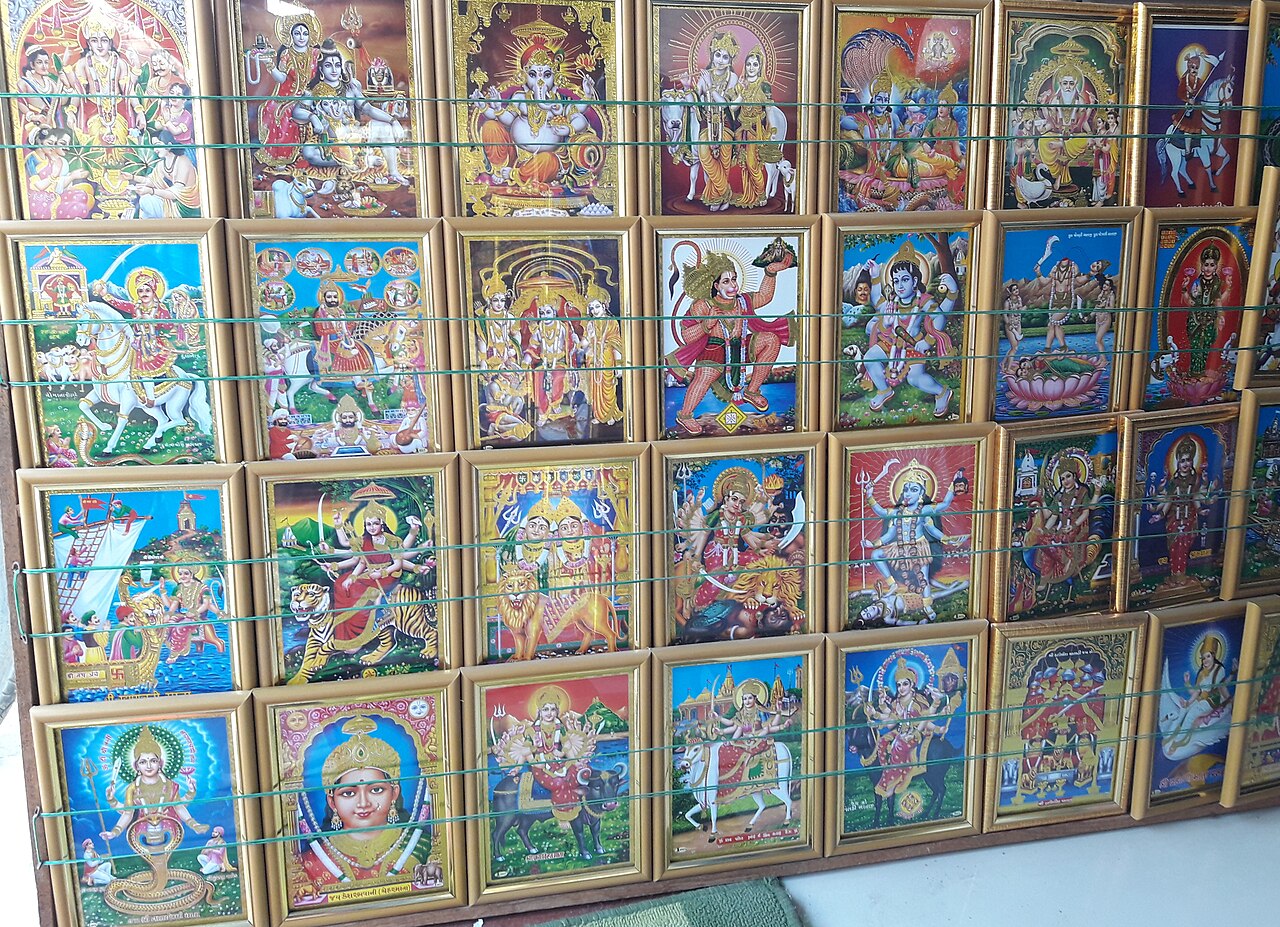
This verse is not a late Advaitic gloss retrofitted onto older polytheistic material. It is itself a claim, made within the Vedic corpus, that the various named deities are alternate designations for a single underlying reality, addressed differently by different sages, in different contexts, for different purposes. Advaita takes this principle and gives it full philosophical weight: every named deity — Vishnu, Shiva, Devi, Ganesha, Surya, and by extension the vast layer of regional and village deities this whole essay series has already spent real time defending — functions as a nama-rupa, a name-and-form, through which the single Ishvara is approached, personified, and related to. The deities are not rival claimants to godhood. They are the same underlying reality, differently refracted.
The lived practice built on this principle actually operates through three distinct mechanisms, anchored at three different levels of a person's identity, and it is worth being precise about each rather than collapsing them into one.
Kula-devata is the family or clan deity, inherited by birth into a specific lineage and worshipped continuously across that family's generations. This is not a matter of personal preference at all — one does not select a kula-devata any more than one selects the family one is born into, and it typically remains constant across every member of that lineage regardless of individual temperament.
Grama-devata is the guardian deity of a village or locality, fixed by geography and community membership rather than by lineage or personal inclination. This is precisely the category Ayyanar, Muniyappar, and Mariamman belong to, already examined at length elsewhere in this series — everyone residing within a given village's boundary shares the same grama-devata, regardless of which family they belong to or what their personal devotional inclinations might otherwise be.
Ishta-devata, by contrast, is genuinely personal and elective — one's own chosen or preferred deity, adopted as an individual gateway into Ishvara based on temperament, a guru's guidance, or a specific felt affinity discovered through practice. This is the one category that is expected to vary between individuals: it is entirely ordinary for a devotee's ishta-devata to differ from a sibling's, a spouse's, or a parent's, without this generating any theological tension whatsoever, precisely because ishta-devata operates at the level of individual spiritual temperament rather than inherited family or communal identity.
None of these three choices, across any of the three categories, implies that anyone else's kula-devata, grama-devata, or ishta-devata is false, lesser, or a stepping-stone toward some more correct object of worship. This is precisely why the question "which Hindu god is the real one" is a category error from inside the tradition's own framework: it assumes a single competition where the actual framework recognizes at least three independent, non-competing axes along which a person's devotional life is organized.
Shankara himself is traditionally credited with the institutional embodiment of this principle: Panchayatana puja, the worship of five deities together — Shiva, Vishnu, Devi, Ganesha, and Surya — arranged as equal points around a shared center rather than ranked in sequence. This is not devotional hedging, a cautious refusal to commit. It is the doctrine of nama-rupa enacted in ritual form: five genuine doors into the same single reality, none elevated above the others by the practice itself.
Part Five: The Functional Roles Within the Plurality
Within this plurality, several recognizable patterns recur, and they are worth naming individually because each does slightly different theological work.
The Trimurti — Brahma, Vishnu, Shiva — personifies Ishvara's three cosmic functions: creation, preservation, and dissolution (srishti, sthiti, samhara), three faces of a single ongoing activity rather than three separate gods dividing up a job. Sectarian traditions built on Vaishnava or Shaiva theology later elevate one member of this triad to full, independent Ishvara-status, treating the others as subordinate — but the underlying Smarta and Advaitic framework does not require this ranking at all.
Devi, or Shakti, occupies a particularly direct position in this scheme. In Shakta theology, Shakti and Maya are frequently treated as simply two names for the same reality — meaning that worship of Devi is, in a quite literal sense, worship of the very creative power that produces the universe, given a face, a mythology, and a relationship a devotee can actually enter into.
Avataras — Rama, Krishna, and Vishnu's other traditional descents — represent yet another mechanism: Ishvara assuming a particular Sakara form for a specific purpose, era, or crisis, without ceasing, underneath that form, to be the single Ishvara whose nature never actually changes.
Ganesha and Surya, the remaining two members of the Panchayatana, each anchor a different functional register again. Ganesha, as remover of obstacles (vighna-harta) and lord of beginnings, occupies the specific devotional role of the threshold-guardian — invoked first, before any undertaking, in a way that mirrors at the pan-Indian level exactly the boundary-guarding function a village deity like Ayyanar performs at the local level. Surya, worship of the visible sun, represents perhaps the most direct and universally accessible nama-rupa of all: a form of Ishvara that requires no temple, no murti, no priestly mediation, visible every single day to anyone who simply looks up, and for that reason retained as a living daily practice (the recitation of the Surya namaskara and the Gayatri mantra at dawn) across sectarian lines that otherwise disagree about nearly everything else.
The village deities — Ayyanar, Muniyappar, Mariamman, and the countless local grama devatas already treated at length elsewhere in this series — function identically in structure to their pan-Indian counterparts, even in the many cases where they were never absorbed into any Puranic genealogy at all. A fierce guardian protecting one specific village's boundary is a local personification of protective divine power in exactly the same sense that a great pan-Indian deity is a personification of a cosmic function. Some village deities do get absorbed into the wider Puranic system through the process of universalization already discussed — Ayyanar's own progressive identification with Hariharaputra and then Ayyappan being a documented case in point. Many others never are, and lose nothing theologically by remaining local. The nama-rupa principle does not require pan-Indian recognition to be operative. It only requires that the form in question be a genuine door into Ishvara for the people who actually worship through it.
Part Six: Where Advaita Actually Differs From Its Rivals
Here is where the philosophical stakes of this essay's title become concrete, because Advaita's treatment of Ishvara as an open category with no fixed occupant is not shared by the other two major schools of Vedanta, and the difference is structural, not merely a matter of emphasis.
Ramanuja's Vishishtadvaita fixes Ishvara's identity doctrinally: Brahman is Narayana, inseparably accompanied by Sri (Lakshmi) as his eternal consort and creative power. This is not a preferred personal devotion operating within an otherwise open framework — it is the actual content of the system's metaphysics. The qualified non-dualism Ramanuja builds treats the world and individual souls as real, eternal modes (prakara) of this specifically Vaishnava Brahman, not as reflections or delimitations of an underlying reality that could equally well be approached through Shiva or Devi instead.
Madhva's Dvaita goes further still, constructing an explicit graded hierarchy of reality, tāratamya, with Vishnu positioned as the sole fully independent (svatantra) reality and every other being — other deities included, Shiva and Brahma explicitly ranked among them — situated at various levels of dependent existence beneath him. Madhva's own tradition centers this devotionally on Krishna as Vishnu's complete and paradigmatic form, a doctrinal commitment rather than an ishta-devata choice made within a pluralistic frame. Both schools built substantial, enduring institutions around these fixed identifications — Ramanuja's Sri Vaishnava tradition centered on temple complexes like Srirangam, Madhva's own matha lineage centered at Udupi — meaning the doctrinal fixing of Ishvara's identity was never merely an abstract philosophical position confined to commentarial texts. It shaped, and continues to shape, the actual devotional architecture and institutional life of millions of practitioners across South India in particular.
A less widely known but structurally important parallel exists on the Shaiva side. Srikantha's Shiva-Vishishtadvaita, built on his own commentary on the Brahma Sutras (the Shaiva-bhashya), constructs essentially the same qualified non-dualist architecture as Ramanuja's system, with Shiva occupying the position Ramanuja assigns to Narayana. This tradition never achieved the same institutional reach or the same centuries-deep body of subsequent commentary that Ramanuja's or Madhva's schools generated, but its very existence confirms something important: the move being critiqued here — fixing Ishvara's identity to one specific deity as a matter of settled doctrine — is a structural feature available to any sectarian tradition sufficiently motivated to build the philosophical apparatus for it. It is not an inherently Vaishnava phenomenon that Shaivism happens to avoid. It is a choice about whether Ishvara is an open category or a closed one, and different schools have made that choice differently.
Advaita, distinctively among the major schools, declines to make this closure at all. Ishvara remains a category with genuinely interchangeable occupants — not because Advaita is theologically indifferent or evasive about which deity matters, but because the entire logic of Maya, nama-rupa, and vyavaharika reality treats fixing that category to one name as a category error, the same kind of error as mistaking any other vyavaharika practice for the paramarthika truth it was only ever pointing toward.
Part Seven: The Honest Complication
It would be incomplete, and inconsistent with how this whole series has tried to handle its own claims, to present either Pratibimba-vada or Avaccheda-vada as a fully settled, unproblematic account of how Ishvara relates to Brahman. Both models, for all their explanatory power, have been criticized — including from within the broader Advaita tradition itself — for not fully escaping a subtle, residual duality.
A reflection still implies two things standing in genuine relation: an original and a mirror-image, however much the model insists the original remains untouched by the image's quality. Pot-space still implies two things: space itself, and a pot creating the appearance of its division, however illusory that dividing power is said to be. Both analogies, in other words, risk quietly smuggling back in exactly the two-term relationship that Advaita's core claim — Brahman alone is real, without a second — is meant to rule out from the very beginning.
This is part of why some later scholars have argued that Shankara's own sparser formulation — Maya as anirvachaniya, simply indeterminable as either existent or non-existent, with no explanatory analogy offered at all — is philosophically safer than either of the later systematic elaborations built to explain it. The moment a school reaches for an image adequate to explain the mechanism, it has already reintroduced some measure of the very two-ness the doctrine exists to dissolve. Pratibimba-vada and Avaccheda-vada are genuinely useful teaching devices, adhyaropa in the fullest sense — but like every other piece of adhyaropa this series has examined, they are scaffolding, not the final word, and a careful reader should hold them exactly that loosely.
Conclusion: The Throne Nobody Keeps
Return, finally, to the question this essay opened with: when a devotee prays to Shiva, or Vishnu, or Devi, or a village guardian standing watch at a threshold few outsiders have ever heard of, what exactly are they praying to? Advaita's answer, worked out across two competing technical models, a precise asymmetry between Ishvara and the jiva, a Vedic warrant older than the philosophy built on it, and a sharp, honest contrast with its Vedantic rivals, comes down to this: they are praying to Ishvara — Brahman under the condition of Maya, genuinely real at the level prayer operates on, genuinely worthy of devotion — wearing whichever name and form that devotee's own tradition, temperament, and lineage have handed them.
No deity holds that seat permanently. None was ever meant to. The wise, the Rig Veda already knew, simply call it by many names.