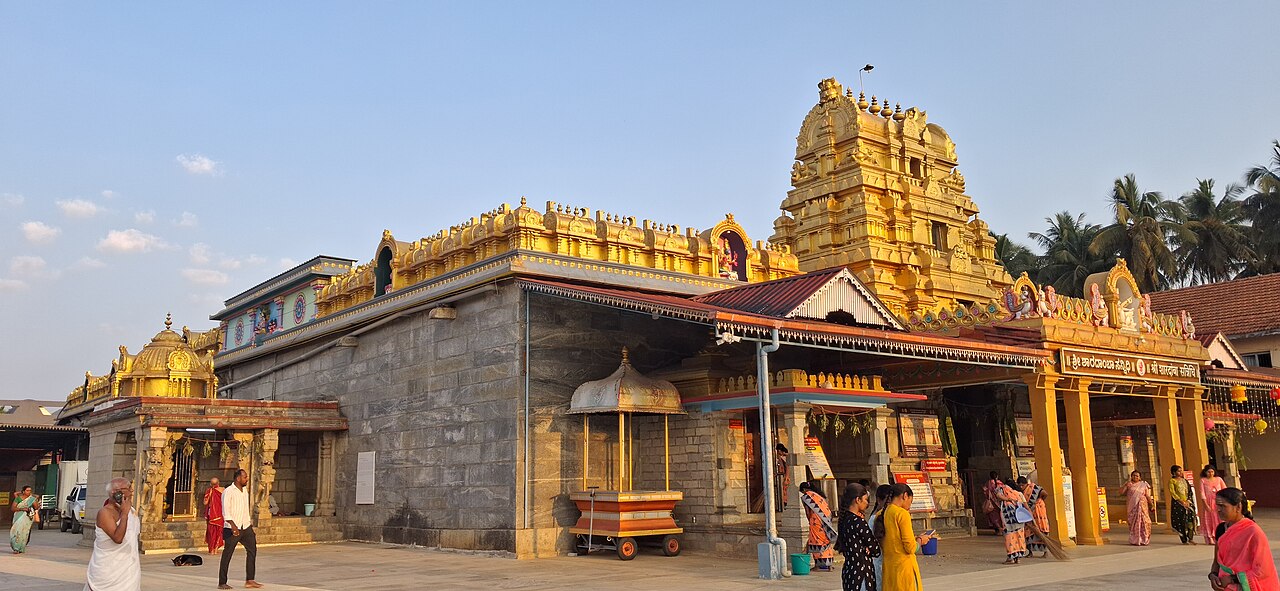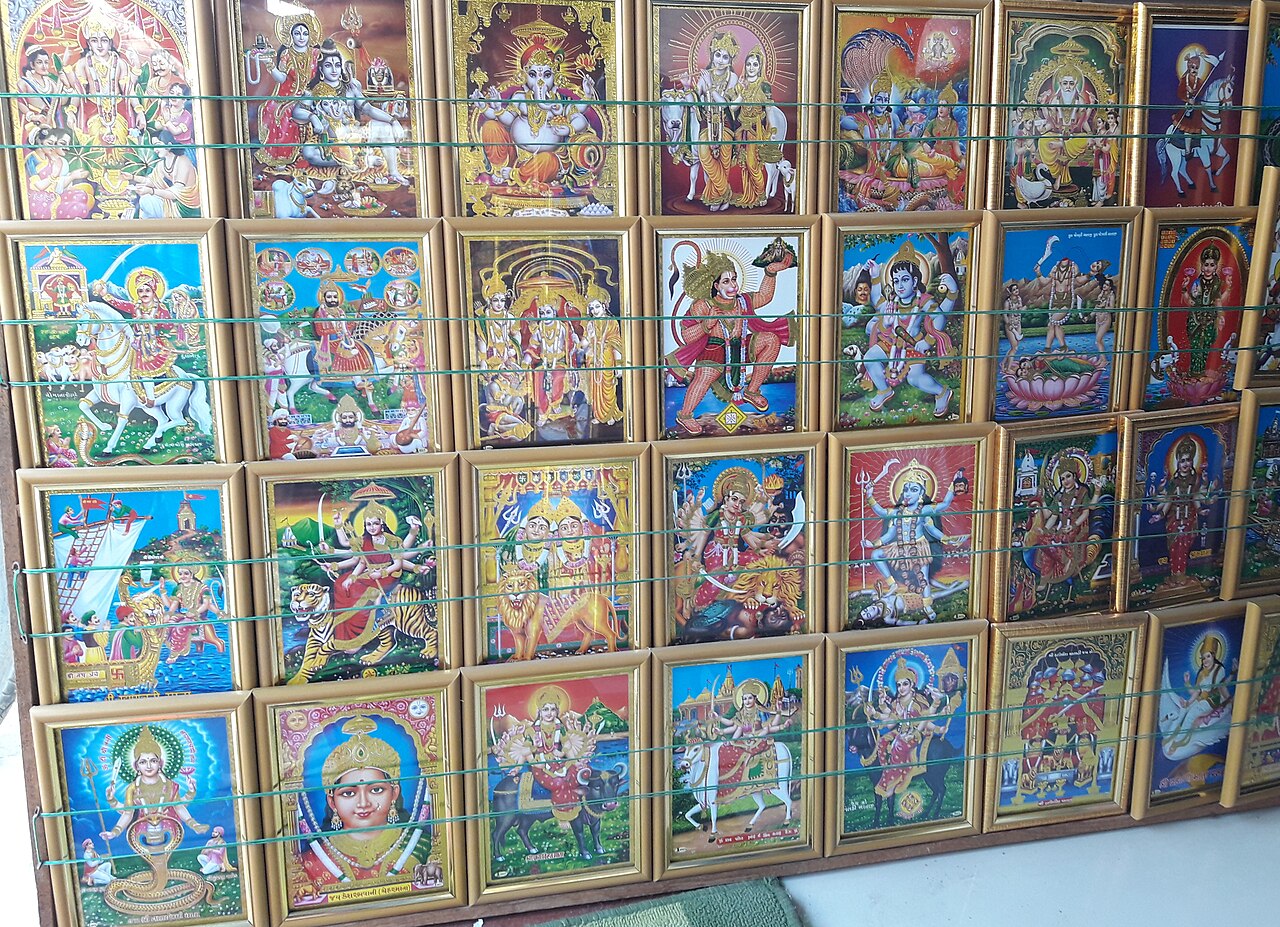
There is a specific, common confusion worth naming plainly, because it sits at the heart of how many people privately rank the various forms of Hindu worship against each other. Someone who worships a murti — Krishna, Devi, Shiva in a specific iconic form — is often quietly assumed to be doing something less philosophically advanced than someone who worships a formless God, no image, no icon, just an omniscient, omnipotent presence addressed in prayer. The formless worshipper is assumed to be closer to the real thing, closer to the Advaitic absolute, further along the path toward Brahman itself.
This essay makes one plain claim against that assumption: it is false. Removing the form from an object of worship does not bring you one step closer to Nirguna Brahman. It cannot, because Nirguna Brahman is not the kind of thing that can be worshipped at all — with or without a form. What actually happens when someone worships a formless God is that they have swapped one vyavaharika object of devotion for another vyavaharika object of devotion. Sakara worship and Nirakara worship are the same distance from the absolute. Neither is closer. Neither is worship of Nirguna Brahman, because nothing can be.
Part One: The Two Brahmans, Properly Defined
Advaita Vedanta works with a genuine, load-bearing distinction between two ways of speaking about Brahman, and getting this distinction exactly right is the foundation everything else in this essay depends on.
Nirguna Brahman — Brahman without qualities — is the paramarthika reality: pure existence-consciousness-bliss (sat-chit-ananda), one without a second (advitiya), beyond every predicate that could be attached to it. This is not a "very abstract quality" Brahman happens to have. It is the absence of the entire category of qualification. The Upanishads describe it through negation rather than description — the Brihadaranyaka Upanishad's famous neti neti, "not this, not this," which does not identify Brahman with some subtle final thing left over after everything else has been eliminated, but denies that any positive characterization, however refined, actually reaches it.
Saguna Brahman — Brahman with qualities — is Ishvara: the same Brahman, but considered in relation to Maya, its own power of appearance. Ishvara is omniscient, omnipotent, the material and efficient cause of the universe, the one who hears prayers, grants boons, incarnates, dissolves worlds and creates them again. Ishvara is completely real at the level Ishvara operates on. But Ishvara is defined by a relationship — to Maya, to the created world, to devotees — and a relationship requires two terms. As the scholar Anantanand Rambachan puts it with real precision: Ishvara is related to the world and defined through that relationship, whereas Nirguna Brahman is Brahman-in-itself, beyond all definition, including the definition "related to something."
This is not a hierarchy where Ishvara is a lesser, false God and Nirguna Brahman the real one hiding behind it. Shankara is explicit that both descriptions point at the same single reality, considered from two different standpoints — one conditioned by Maya (Saguna), one not (Nirguna). But only one of those two standpoints is capable of being related to, addressed, prayed to, or loved. Only one of them is, in the ordinary sense of the word, a "God."
The Mandukya Upanishad's description of turiya, the "fourth" state of consciousness beyond waking, dream, and dreamless sleep, gives the clearest available picture of what a genuine attempt to describe Nirguna Brahman actually looks like on the page, and it is worth reading closely because of how carefully it refuses every positive characterization offered to it. Turiya is described as neither inwardly cognitive nor outwardly cognitive, neither a mass of cognition nor without cognition, unseen, ungraspable, without distinguishing mark, unthinkable, incapable of being designated — a string of negations so relentless that the text itself seems to be actively resisting the reader's urge to convert each negation into some subtler positive claim. This is not poetic reticence. It is the only honest way language can gesture at something that is not one more item alongside other items, not a superlative version of anything already familiar, but the ground on which the very distinction between "this" and "not this" gets its meaning in the first place.
Part Two: Worship Requires Two, and Nirguna Brahman Is Never Two
Here is the argument stated at its simplest: worship — upasana, puja, bhakti, prayer in any of its forms — is a relationship. It requires a worshipper and something worshipped, a subject reaching toward an object, however devotionally that reaching is described. Even the most refined mystical language of union and merging still describes two things approaching each other before any merging occurs.
Nirguna Brahman, by definition, is advaita — without a second. There is no "other" for it to be related to, because positing an "other" is precisely the operation Nirguna Brahman is defined as being prior to and beyond. It cannot be prayed to, because prayer requires a person praying and a God being prayed to, and that is already two, and Nirguna Brahman rules out two.
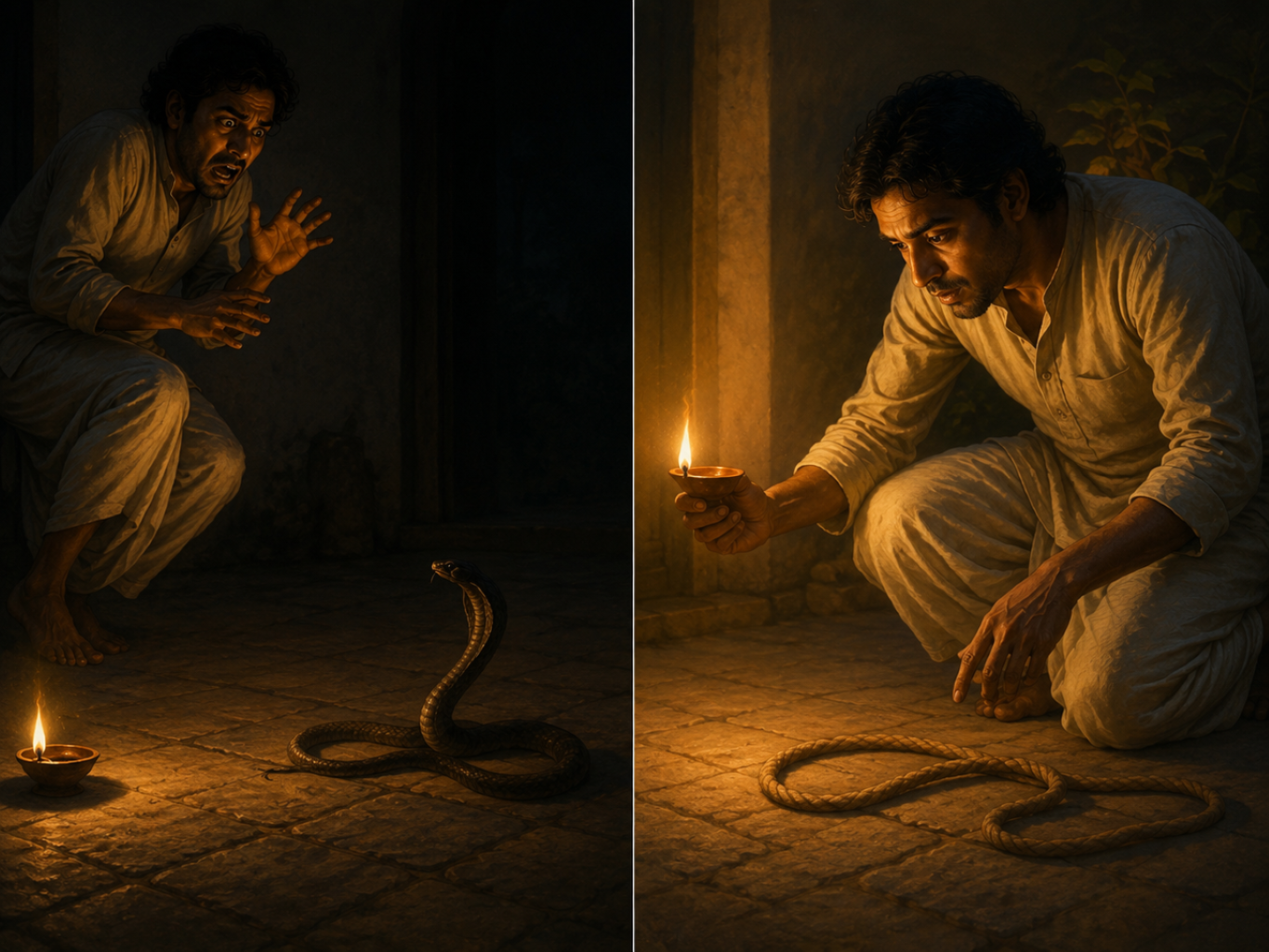
This is why the tradition's own vocabulary keeps these paths separate rather than treating them as interchangeable synonyms. Devotion, worship, prayer, ritual — upasana in its many forms — are practices addressed to Ishvara, to Saguna Brahman, and are described accordingly using relational language: surrender, grace, service, love. What is addressed to Nirguna Brahman is never called worship. It is called jnana — knowledge, realization, direct recognition. You do not worship your way into recognizing that you are already what you were looking for. You come to see it, the way a mistaken rope-for-snake perception dissolves into correct seeing rather than being placated, negotiated with, or prayed to.
This distinction is not incidental to Advaita. It is close to the entire architecture of the system. Upasana purifies the mind (citta-shuddhi) and prepares it for jnana, exactly as we've traced elsewhere in how karma functions as preparation rather than direct cause of liberation. Worship of Ishvara — in whatever form — belongs to this preparatory register. It readies a mind for the moment jnana can land. It is not itself that moment, and it cannot be, because jnana's content — you are already, right now, not-other-than Brahman — cannot be delivered by a practice that presupposes exactly the distinction between "you" and "God" that the jnana in question is going to dissolve.
Part Three: The Confusion The Title Of This Essay Is Naming
Here is where the specific error this essay is built around actually happens. People correctly grasp that Nirakara Saguna Brahman is formless. They then, incorrectly, run the inference backward: formless, therefore closer to Nirguna Brahman — as if removing the visual form from an object of worship strips away exactly the layer of illusion or conditioning that separates ordinary devotion from the real, final truth.
This gets the actual axis of the distinction wrong. Form (akara) and quality (guna) are not the same thing, and removing one does not remove the other. A scholar writing directly on this exact confusion, Dr. Subhash C. Sharma, states the correction plainly, addressing precisely the case of formless devotional movements: those who pray to and worship a formless God — his example is the nirakara worship practiced in traditions like the Arya Samaj — are, in reality, still worshipping Saguna Brahman, not Nirguna Brahman directly. The formless God they address still possesses attributes: omnipotence, omniscience, the capacity to hear a prayer and respond to it. Only the specific attribute of visible form has been subtracted. Every other qualification remains fully intact. A God who lacks a shape but still knows, still hears, still acts, still relates, is exactly as Saguna — exactly as thoroughly a Maya-conditioned Ishvara — as a God worshipped through an iconic murti. Nirakara Saguna is still Saguna. It has not become Nirguna by losing its shape.
The Upanishads themselves already contain the vocabulary needed to see this clearly, and it is worth having the precise textual anchor rather than just the argument. The Brihadaranyaka Upanishad states directly: dve vāva brahmaṇo rūpe, mūrtaṃ caivāmūrtaṃ ca — "Brahman has two forms (rupa): the formed (murta) and the formless (amurta)." Notice exactly what this verse is doing. It does not say Brahman has one form and one formless absolute standing behind that form. It calls both the formed and the formless modes rupa — form, in the broader sense of a describable, delimited mode of manifestation. The formless mode of Ishvara is still, by the Upanishad's own classification, a rupa of Brahman — one of the two rupas explicitly named — not the rupa-transcending Nirguna reality itself. Formlessness, on the Upanishads' own accounting, is a variety of form, not an escape from form altogether.
Part Four: What Actually Changes Between Sakara and Nirakara Worship, and What Does Not
Given all this, it is worth being precise about what genuinely differs between worshipping Krishna in a murti and worshipping an unvisualized, formless, omniscient presence — because something does differ, even if it is not what people usually assume.
What differs is the practice: the psychological and devotional technique involved. Sakara worship gives the mind a concrete, sensorily engaging focus — a specific face, a specific story, a specific relationship the devotee can enter into with real emotional particularity. Nirakara worship trains a different kind of attention, one that holds devotion toward a presence without letting the mind rest on any single visualized form, which some traditions and temperaments find more suited to their own contemplative style. The Bhagavad Gita itself, in its twelfth chapter, acknowledges this practical difference directly, noting that steady devotion to the unmanifest (avyakta) is a genuinely harder discipline for an embodied mind to sustain than devotion to a manifest, particular form — not because the unmanifest is philosophically superior, but because concrete form gives ordinary minds something to hold onto that the formless does not.
What does not differ is ontological status. Both the Krishna murti and the formless omniscient presence are Ishvara — Saguna Brahman, Brahman conditioned by Maya, defined by a relationship to a devotee. Both are equally vyavaharika. Neither is nearer to Nirguna Brahman than the other, because "nearness" is not actually the axis either one is being measured on. A murti is not a diluted, degraded version of the formless God standing one philosophical rung further from the truth. It is a different practical technique pointed at the identical ontological reality: Ishvara, prepared through devotion for a jnana that neither form of worship can itself deliver.
This is, in fact, precisely how the Smarta tradition has always framed the question. Murtis — and by extension any anicon, symbol, or formless devotional focus — are treated as genuinely convenient, genuinely effective means, multiple representations of a single underlying reality rather than competing or ranked claims about which representation is truest. The traditional five-fold Panchayatana worship of Shiva, Vishnu, Devi, Ganesha, and Surya together, sometimes alongside a formless focus in meditation, is not treated as devotional inconsistency or hedging between incompatible options. It is the same insight this essay is arguing for, already built into the practice: all of these are equally provisional, equally vyavaharika, equally valid steps toward a jnana that lies past every one of them without exception, form and formless alike.
The nineteenth-century reform movements make a genuinely instructive test case for this argument, because they are exactly where the "formless equals more advanced" intuition took organised, institutional form. The Brahmo Samaj, founded by Ram Mohan Roy, and the Arya Samaj, founded by Dayananda Saraswati, both built entire religious reform projects around rejecting murti worship in favour of worship of a single, formless, attributed God — explicitly positioning this as a philosophical advance over what they characterised as the superstition of image worship. Whatever the social and historical merits of that reform impulse, considered purely on the philosophical question this essay is concerned with, the reformers were not worshipping a reality any closer to Nirguna Brahman than the murti worship they were reacting against. They had swapped one Saguna object of devotion for a different Saguna object of devotion, and the swap changed the psychological texture of the practice without changing its ontological distance from the absolute by so much as a single step. A formless, reasoned, ethically-inflected monotheism is not quieter or more advanced metaphysics than a Shiva lingam or a Devi murti. It is a different rupa of the identical Ishvara, exactly as bound to Maya, exactly as incapable of being the final truth.
Part Five: Why Nirguna Brahman Can Only Be Known, Never Approached
There is a deeper reason worship cannot reach Nirguna Brahman, beyond the simple observation that worship requires two, and it is worth making explicit because it forecloses a natural attempt to rescue the "formless is closer" intuition.
Someone might concede everything argued so far and still propose: fine, Nirakara Saguna is not Nirguna Brahman, but perhaps sustained enough formless devotion gradually approaches Nirguna Brahman asymptotically — getting closer and closer, even if never quite arriving, the way strict qualities can sometimes be worn away by degrees. This does not work, and the reason it does not work is the same reason that spans everything examined elsewhere in this whole body of essays: Nirguna Brahman is not a further point along the same scale that Saguna Brahman sits on. It is not "more" formless, "more" quality-less, "more" abstract than Ishvara. It is the negation of the entire scale, not an extreme position on it.
This is also why "Nirguna" itself must be handled carefully as a term, on pain of self-contradiction. If "being without qualities" were asserted as a positive, describable property Brahman possesses, then quality-lessness would itself be a quality — a subtle but real qualification, no different in kind from omniscience or omnipotence, just harder to notice as one. Shankara's own use of Nirguna does not fall into this trap: it functions as a negation pointing past the entire apparatus of attribution, the same logical move Gaudapada's ajativada makes about origination itself, and the same move behind neti neti's refusal to let any final positive description stand. Nirguna Brahman is not the last, subtlest attribute in the series. It is the recognition that the entire series of attribution was never adequate to what it was trying to describe, form and formlessness both included.
Consider what the asymptote proposal would actually require if it worked. It would require that some finite amount of additional devotional refinement — one more subtracted attribute, one further layer of abstraction stripped away — eventually crosses a threshold into the unconditioned. But thresholds and crossings are themselves relational, temporal, quantitative notions, exactly the vocabulary that only makes sense within the vyavaharika order Nirguna Brahman lies outside of. Asking how much closer sustained Nirakara devotion gets you to Nirguna Brahman is asking a question shaped like a vyavaharika question — how much progress, measured against what scale, arriving when — applied to something that admits no such measurement at all. The question is not merely unanswered. It fails to describe anything the answer could refer to.
Devotion, however sustained, however sincere, operates entirely within that series. It cannot exit the series through more devotion, the way you cannot exit a room by walking further into it. What actually delivers Nirguna Brahman is jnana — direct recognition, not additional practice of the same kind stacked higher. This is precisely why the tradition treats upasana as preparation and never as the mechanism itself: the mind made steady, clear, and purified through worship of Ishvara — in any form, with or without a shape — becomes a mind capable of hearing the Upanishadic teaching correctly when it is finally given, and it is that hearing, not the years of worship preceding it, that actually removes the ignorance.
Part Six: A Fair Hearing for the Opposite View
It would be dishonest to present this essay's framework as the only serious position Hindu philosophy has taken on the relationship between form and ultimate reality, and worth pausing to give the strongest opposing view its due before returning to why this essay is written from the Advaita standpoint specifically.
Certain Vaishnava traditions, most explicitly Chaitanya's Achintya-bheda-abheda school, argue for something close to the reverse ordering: that Krishna's own original, eternal, spiritual form is not a vyavaharika manifestation of an impersonal Nirguna Brahman at all, but is itself the source from which the impersonal Brahman derives, a position with real scriptural anchoring in Bhagavad Gita 14.27, where Krishna states directly that he is the foundation (pratishtha) of Brahman. On this view, the impersonal, formless absolute is the derivative reality, and Krishna's personal form is primary — which inverts this essay's ranking entirely, treating Sakara not as equally provisional alongside Nirakara but as ontologically prior to any formless conception whatsoever.
This is a serious, textually grounded position within the wider Hindu tradition, not a naive devotional error, and an honest essay should say so plainly rather than pretending Advaita's framework is the only available reading of the sources. What can be said in response, from within the Advaita position this essay is written from, is that Shankara's tradition reads verses like Gita 14.27 differently — as describing Krishna's own manifest, avatara form as itself already Saguna, already an expression of Ishvara for the sake of relationship with devotees, rather than as evidence that personal form precedes and grounds the impersonal absolute. The disagreement between these two readings is a real, substantive one between Advaita and Vaishnava theology, not a confusion to be tidied away, and this essay does not pretend to adjudicate it. What it does claim is narrower and, within the Advaita framework specifically, secure: given Shankara's own architecture, in which Nirguna Brahman is defined precisely as beyond relationship altogether, nothing that can be related to — including any form, however primary a given tradition holds it to be — occupies that position. Readers coming from a Vaishnava standpoint will reasonably weigh the sources differently, and that disagreement is worth naming honestly rather than smoothed over.
Part Seven: Why This Confusion Is So Tempting
It is worth asking, briefly, why the "formless is closer to the truth" intuition is so widespread and so persistent, given that it does not survive the analysis above. The honest answer is that it trades on a real, understandable, but ultimately misleading analogy: the process of philosophical abstraction genuinely does involve stripping away particulars to reach something more general, and formlessness feels like the natural end-point of that stripping-away, the way removing decoration from an argument leaves its bare logical structure exposed. If a specific face and story feels like the most "concrete" and least "abstract" layer of a devotional object, then removing the face and story feels like movement toward abstraction, and abstraction quietly gets equated with philosophical depth.
The error is mistaking a psychological gradient — how concrete or abstract an object of devotion feels to the mind holding it — for an ontological gradient measuring actual distance from Nirguna Brahman. Nirguna Brahman is not "very abstract." It is not on the abstraction scale at all, because the abstraction scale is itself a relation between a mind and its objects, and Nirguna Brahman is prior to the entire subject-object structure that scale is measured within. A formless God still sits on that scale, simply further along the "feels abstract" end than a murti does. Neither position on that scale, however far along it you travel, actually steps outside the scale altogether — and stepping outside the scale altogether, not travelling further along it, is what jnana of Nirguna Brahman would actually require.
Part Eight: What This Means in Practice
None of this is an argument against worship, and it would be a serious misreading to take it as one. Everything argued in the essays on Shankara's own relationship to ritual and devotion applies here without modification: upasana is genuinely necessary for virtually everyone, genuinely binding as a stage of practice, and genuinely valuable regardless of whether the object of that devotion carries a form or not. Nothing here licenses treating devotion as dispensable or unserious.
What it does license, and what is worth holding onto with real clarity, is this: there is no devotional hierarchy running from murti worship at the bottom to formless worship near the top, with Nirguna Brahman as the final rung above both. Sakara and Nirakara worship of Ishvara are lateral options, not sequential stages — different techniques suited to different temperaments, equally provisional, equally vyavaharika, equally distant from a paramarthika reality that neither one, by its own nature as worship, was ever going to reach. Choose whichever form suits the mind you actually have. The choice between them is a question of practice and temperament, not a question of how close you are getting to the truth.
And when the truth does arrive, it will not arrive as a more refined object of devotion, however formless. It will arrive as the recognition that there was never anyone separate praying to anyone separate at all — which is a very different thing than finally managing to pray correctly.
Nirguna Brahman is not the God you pray to. It is what you find out you already are, once there is no longer any praying left to do.