There is a question at the heart of Advaita Vedanta that the tradition has never fully resolved — and that its most honest teachers have acknowledged cannot be fully resolved. It is this:
If Brahman alone is real, pure, undivided, and without modification — how did the appearance of ignorance and multiplicity arise?
This is not a peripheral question. It cuts to the centre of the Advaitic enterprise. The entire philosophical project of Advaita is built on the claim that the world of multiplicity — the world of individual souls, distinct objects, space, time, and causation — is not ultimately real. It is an appearance. And the mechanism that produces this appearance is called Maya. The ignorance that causes the individual to mistake the appearance for reality is called Avidya.
But what exactly are Maya and Avidya? Where do they reside? When did they begin? How does an all-knowing, all-pervading, unchanging Brahman come to appear as an ignorant, limited, suffering individual soul?
Three positions have been offered within the Advaitic tradition — by Gaudapada, by Adi Shankaracharya, and by the standard scholastic Advaita that followed Shankara. Each is philosophically serious. Each faces genuine difficulties. And all three, at their most honest, acknowledge that the question of Maya's ultimate origin cannot be answered within any rational framework — because the framework of rational explanation is itself a product of Maya.
This essay examines all three positions carefully and honestly.
Part One: Gaudapada — The Most Radical Answer
Gaudapada was Shankara's grand-teacher — the teacher of Shankara's teacher Govindapada. His Mandukya Karika, a commentary on the Mandukya Upanishad, represents the most radical position in the entire Advaitic tradition. His doctrine is called ajativada — the doctrine of non-origination.
For Gaudapada, the question of how Maya arose and how ignorance came to affect Brahman does not arise — because nothing ever arose. There is no creation. There are no individual souls that fell into bondage. There is no cosmic process of Maya producing the world. Brahman alone exists, in a condition of absolute, undisturbed non-duality that has never been modified.
The Mandukya Karika states this without qualification:
न निरोधो न चोत्पत्तिर्न बद्धो न च साधकः।
न मुमुक्षुर्न वै मुक्त इत्येषा परमार्थता।।
Na nirodho na cotpattir na baddho na ca sādhakaḥ.
Na mumukṣur na vai mukta ityeṣā paramārthatā.
"There is no dissolution, no creation, no one in bondage, no one seeking liberation, no one liberated. This is the ultimate truth." (Mandukya Karika 2.32)
The appearance of the world and individual souls is, for Gaudapada, exactly analogous to a dream. In the dream, multiple objects appear, multiple persons interact, events unfold with apparent causal sequence. On waking, it is recognised that none of this actually happened. No objects were created. No persons existed. No events occurred. The dreaming mind alone was present, appearing as multiplicity to itself.
Gaudapada's term for this is vaitathya — unreality, falsity. The world is as unreal as a dream. And just as asking "where did the dream world come from?" is answered simply by "from the dreaming mind, which was not truly affected by its own dream," the question of how the world arose is answered: from Brahman appearing as multiplicity to itself, without being truly affected or modified.
The philosophical strength of Gaudapada's position: It completely dissolves the problem of Maya's origin. If nothing ever arose, there is nothing to explain. Brahman's purity, immutability, and non-duality are preserved without remainder. No cosmic power of Maya needs to be posited alongside Brahman. No mechanism of creation needs to be explained.
The philosophical difficulty: If no one is bound, who is being liberated? If no ignorance actually arose, what is the point of philosophical inquiry, meditation, and spiritual practice? Gaudapada's answer — that these too are appearances within the dream, useful within the appearance but not ultimately real — is logically consistent but practically unsatisfying. It makes the entire enterprise of the spiritual path appear as a dream within a dream — useful for the dreamer, ultimately pointing beyond itself to the recognition that the dreamer was always awake.
Gaudapada's position is the most philosophically consistent formulation of non-dualism available. It is also the most difficult to live from.
Part Two: Shankara — The Indefinable Appearance
Shankara accepts Gaudapada's ultimate conclusion — Brahman alone is ultimately real — but takes a different approach to the appearance of the world. His position is called vivartavada — the doctrine of apparent manifestation, as distinct from parinamavada (the doctrine of real transformation, which Ramanuja accepts).
For Shankara, the world is not nothing. Dismissing it as pure nothingness would make the entire human experience — including the experience of suffering, seeking, and liberation — inexplicable. The world is mithya — a dependent reality, real within its own order, not real in the ultimate sense.
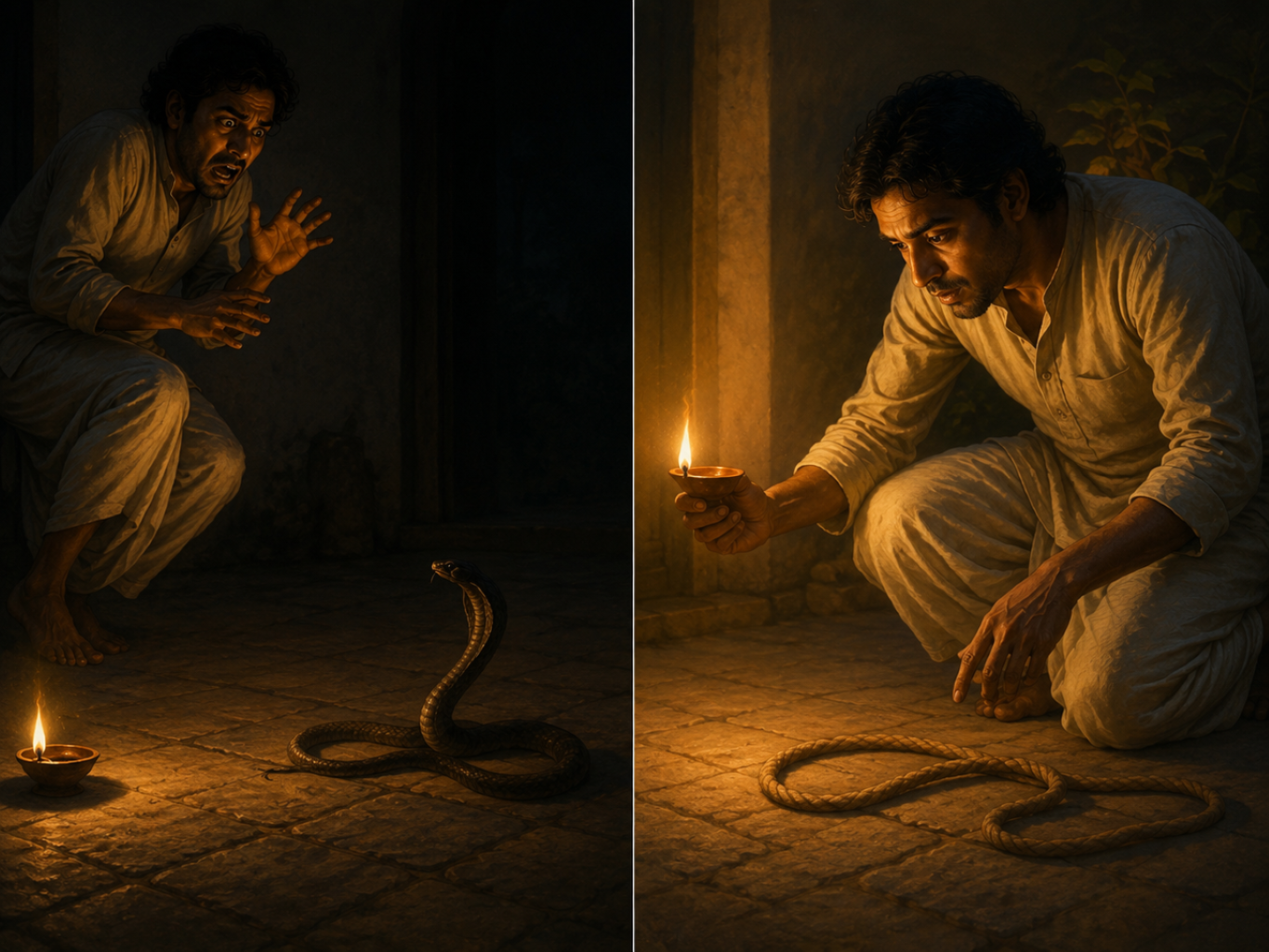
The classic illustration is the rope and the snake. In dim light, a rope lying on the ground is mistaken for a snake. The snake is not real — it never existed as a snake. But the appearance of the snake is not nothing either. It is a genuine appearance, arising due to a specific condition — partial knowledge, insufficient light — and producing genuine effects: fear, avoidance, racing heart. When the rope is seen clearly, the snake disappears. Not because it was destroyed, but because it was never there. The recognition of the rope dissolves the snake along with the fear it produced.
This is how Shankara understands Maya. The world appears real. It produces genuine effects — karma, rebirth, suffering, joy. But when Brahman is directly recognised, the world does not disappear — it continues to appear — but its claim to independent ultimate reality is dissolved. The effects of avidya gradually unwind. The liberated person continues to live in the world but is no longer bound by the misidentification that caused suffering.
The two key concepts in Shankara's account:
Anirvachaniya — indefinable, inexplicable. This is Shankara's honest acknowledgment that Maya cannot be fully categorised. It is neither sat (real in the ultimate sense, which would make it a second reality alongside Brahman) nor asat (unreal in the sense of non-existent, which would make the world's appearance impossible to account for) nor both simultaneously (which would be a logical contradiction). It belongs to a third category that resists the standard categories of rational analysis.
Anadi — beginningless. Maya has no origin in time because time itself is a product of Maya. Asking when Maya began is asking a question within a framework — temporal causation — that Maya itself produces. The question is not unanswerable because we lack information. It is malformed because the framework within which it is posed is itself part of what needs to be explained.
Avidya and Maya — the distinction:
Shankara distinguishes between Maya and Avidya, though they are closely related.
Maya is the cosmic creative power — associated with Ishvara, the personal God — that produces the appearance of the universe at the cosmic level. It is the power by which the one appears as many, the formless appears as formed, the unchanging appears as changing.
Avidya is the specific cognitive ignorance operating at the individual level — the misidentification of the self (Atman) with the body-mind complex (anatman). It is Maya as experienced from the standpoint of the individual jiva.
The famous ashraya problem — where does Avidya reside? — is the sharpest objection to Shankara's position, raised most forcefully by Ramanuja. Avidya cannot reside in Brahman, which is pure undivided consciousness and cannot be the locus of ignorance. It cannot reside in the individual jiva, because the jiva is itself a product of Avidya — making Avidya the cause of the very entity in which it supposedly resides, a circular impossibility.
Shankara's response is characteristically honest: the question of Avidya's locus is asked from within the framework that Avidya produces. To ask for a coherent locus for Avidya within the system of reality that Avidya generates is to demand that the dream explain the dreamer. The question is malformed — not because Shankara cannot answer it, but because answering it would require stepping outside the very framework within which all such questions are posed.
This is not evasion. It is a philosophically principled acknowledgment of the limits of rational explanation when applied to the preconditions of rational explanation itself.
Part Three: The Standard Advaita Position — A Systematic Elaboration
The standard scholastic Advaita that developed after Shankara — through commentators like Vacaspati Mishra, Prakashananda, and the Vivarana school — elaborated and systematised Shankara's insights into a more complete philosophical framework.
Maya has two powers. The first is avarana shakti — the power of concealment. Maya conceals the true nature of Brahman, preventing the individual from recognising what is always already the case. The second is vikshepa shakti — the power of projection. Having concealed the truth, Maya projects the appearance of the world in its place. The rope-snake illustration again: the rope's true nature is first concealed by the inadequate light, and then a snake is projected onto the concealed reality.
Avidya is anadi but not ananta. Maya is beginningless — it has no origin in time. But it is not endless. It has a termination point — the direct recognition of Brahman, aparoksha anubhuti, which dissolves Avidya the way light dissolves darkness. This asymmetry — no beginning, but a definite end — is philosophically important. It means liberation is real and achievable even though the origin of bondage cannot be explained.
Maya is not a second reality alongside Brahman. This is crucial. Maya does not exist independently. It is the power of Brahman itself — specifically of Brahman as Ishvara — and has no existence apart from Brahman. This is why vivartavada differs from dualism: there are not two ultimate realities, Brahman and Maya. There is only Brahman, and Maya is Brahman's own power of apparent self-concealment. The world is mithya — dependent, not independently real — rather than asat (non-existent) or sat (independently real).
The three levels of reality. Standard Advaita distinguishes three levels: paramarthika (ultimate reality — Brahman alone), vyavaharika (conventional reality — the world of everyday experience, which is real at its own level), and pratibhasika (apparent reality — things like the rope-snake or a dream, which are real only while the specific appearance lasts and dissolve immediately on correction). The world of our experience is vyavaharika — genuinely real at the conventional level, not ultimately real at the paramarthika level. This framework allows Advaita to affirm the genuine reality of the world of experience — and the genuine validity of devotion, ethics, and spiritual practice within it — while maintaining that Brahman alone is ultimately real.
Part Four: The Honest Philosophical Limit
All three positions — Gaudapada's ajativada, Shankara's anirvachaniya Maya, and the standard scholastic elaboration — face a common difficulty that deserves honest acknowledgment rather than philosophical glossing over.
The question of how the appearance of ignorance arose — how Brahman, which is pure undivided consciousness, comes to appear as an ignorant, limited, suffering individual — cannot be answered fully within any rational framework. This is not a gap that more philosophical work will eventually close. It is a structural feature of the problem.
Any explanation of Maya's origin would need to use the categories of causation, time, and subject-object distinction — categories that are themselves products of Maya. Explaining Maya in these terms is like trying to see your own eyes directly, or trying to use a ruler to measure itself. The instrument of explanation is implicated in what it is trying to explain.
Shankara was deeply aware of this. His insistence that Maya is anirvachaniya — indefinable — is not a failure of philosophical nerve. It is an honest acknowledgment that the question of Maya's ultimate nature and origin reaches the limits of what rational inquiry can achieve. Beyond those limits lies only the direct recognition — aparoksha anubhuti — of what has always been the case.
This is perhaps the deepest Advaitic insight of all: the question of how ignorance arose is itself a question asked from within ignorance. When ignorance is dissolved, the question dissolves with it. Not because it has been answered, but because the questioner who needed the answer has recognised what they always were.
The snake was never there. The question of where the snake came from dissolves the moment the rope is seen clearly. Not answered. Dissolved.
Conclusion: Why the Honest Limit Is the Right Place to Stop
The three positions examined here represent different strategies for engaging the same fundamental problem — each with genuine philosophical strengths and genuine difficulties.
Gaudapada's ajativada is the most radical and the most logically consistent. Nothing ever arose, so nothing needs to be explained. But it makes the spiritual path and the reality of bondage and liberation difficult to ground.
Shankara's anirvachaniya Maya is more practically grounded — it affirms the genuine reality of the world and the spiritual path at the conventional level while maintaining the ultimate non-dual truth. But it faces the ashraya problem and ultimately must acknowledge that the origin of Maya cannot be explained.
The standard Advaita elaboration systematises Shankara's insights into a comprehensive framework — three levels of reality, two powers of Maya, the distinction between Avidya and Maya — that is philosophically rich and practically useful. But it faces the same ultimate limit.
All three point to the same conclusion: rational philosophy can take the seeker to the edge of the question. What lies beyond the edge is not more philosophy. It is the direct recognition that Shankara calls Brahma-jnana — the knowing of Brahman that is identical with being Brahman.
The snake was never there. Looking for where it came from is, in the end, another way of continuing to look at the rope as if it might still be a snake.
See the rope. That is all.
Maya cannot be explained from within Maya. Avidya cannot be understood from within Avidya. This is not Advaita's failure. It is its most honest teaching.