I. The Weight of Numbers
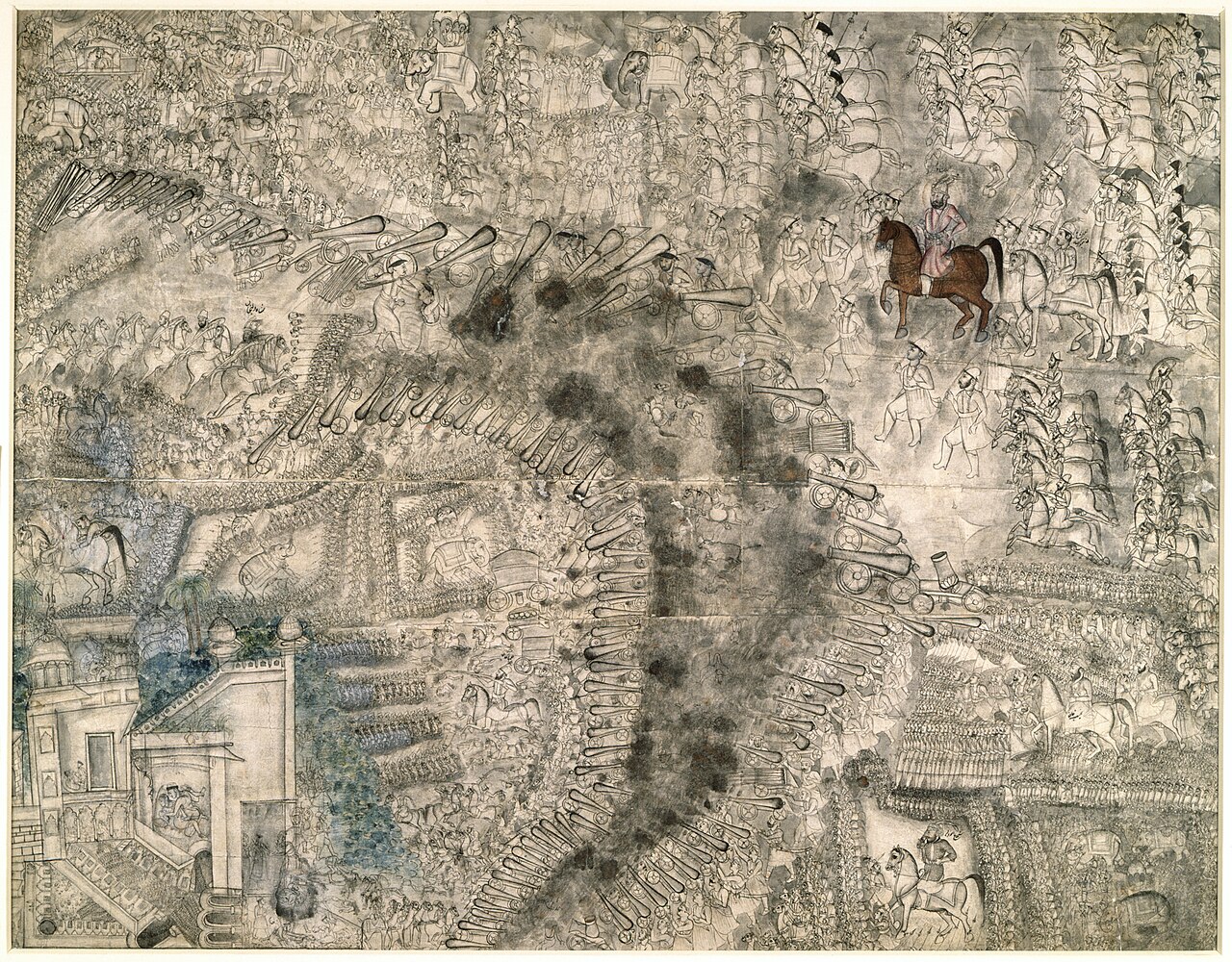
Few single days in world military history match the scale of what happened at Panipat, and the numbers themselves need to be stated plainly before anything else.
The Third Battle of Panipat — By the Numbers
II. The Maratha Zenith and the Afghan Response
To understand why this battle happened at all, it helps to see how extraordinary Maratha power actually was by 1760. Beginning from Shivaji's Deccan kingdom in the previous century, the Marathas had spent decades expanding outward from Maharashtra until, under Peshwa Baji Rao and his successors, their influence and revenue-collecting reach extended across Malwa, Gujarat, and deep into the Gangetic plain — Baji Rao had even entered Delhi itself in 1737. By the 1750s, Maratha cavalry and administrators operated as far north as the Punjab, with some raiding parties reaching Attock on the Indus itself. A later popular phrase for this extent of control — "Attock to Cuttack" — captures something real, even if the phrase itself is a later shorthand: no Indian power since the height of the Mughals had projected authority across so much of the subcontinent at once.
This expansion inevitably collided with Ahmad Shah Abdali, the Afghan ruler who had already invaded India multiple times and who regarded the Punjab, and Delhi's wider political orbit, as properly within his own sphere of influence. Maratha governors pushing into territory Abdali considered his to protect or plunder was, from Kabul's perspective, a direct provocation. Abdali crossed the Indus in October 1760, seized Punjab, and allied himself with Najib-ud-Daula, the Rohilla Afghan chief who had his own longstanding grievances against Maratha encroachment near Delhi.
The Peshwa's initial choice to lead the northern response was his own brother, Raghunathrao, an experienced commander who had led earlier northern campaigns. Raghunathrao, however, asked for a larger force than the Peshwa was willing to commit, and when this was refused, he declined the command. It went instead to Sadashivrao Bhau, the Peshwa's cousin and diwan — an able administrator and a man of real personal courage, but a first-time field commander at this scale, about to face the single most consequential military decision of his life.
III. The Fatal Isolation
Here the honest account must be direct, because this is where the disaster actually began — not on the battlefield in January, but in the diplomacy of the preceding months. Bhau's two most experienced generals, Malharrao Holkar and the Scindia family, both understood something Bhau himself resisted accepting: no campaign against a coalition as formidable as Abdali's could succeed without the active cooperation of the regional powers who controlled the ground between Delhi and Panipat — chief among them Maharaja Suraj Mal, the Jat ruler of Bharatpur, who held decisive influence over the grain supply of the entire region.
Holkar and Scindia pressed hard for this alliance, and initially succeeded despite real obstacles — Suraj Mal had genuine grievances against the Marathas, including a prior clash with Holkar himself, and did not trust Bhau personally. Scindia and Holkar personally guaranteed Suraj Mal's safety to bring him into the camp. Once there, however, Bhau's own arrogance undid the alliance his generals had worked to build. Contemporary accounts describe Bhau treating Suraj Mal with open contempt, at one point reportedly planning to have him arrested outright — a plan Holkar and Scindia had to quietly warn Suraj Mal about themselves, since they had personally vouched for his safety. Suraj Mal, his patience exhausted, eventually left the Maratha camp for Bharatpur without informing Bhau at all.
He did not seek the cooperation of the Jat and Rajput kings while planning for the war with Abdali, but rather planned to punish them later — this led to their non-cooperation and an acute shortage of supplies.
Contemporary assessment of Sadashivrao Bhau's diplomatic conduct before the battleThe Rajput rulers of Rajasthan, for their own part, refused Maratha overtures as well, citing years of Maratha interference in Rajput succession disputes and the imposition of tribute they considered unjust. Whatever the merits of these Rajput grievances — and they were, in fairness, grounded in real prior Maratha conduct rather than invented — the practical result was that Bhau marched to Panipat without Rajput support, without Jat support, and without the Sikh cooperation that might otherwise have been available. Abdali, by contrast, arrived with Najib-ud-Daula's Rohillas and Shuja-ud-Daula's Awadh forces already secured. The isolation was not bad luck. It was substantially self-inflicted.
IV. Three Months on a Starving Plain
By late 1760, the two armies had settled into a prolonged standoff near Panipat, camped within sight of one another for roughly three months. Both sides suffered supply difficulties, but the Maratha position was structurally far worse. The army had marched north accompanied by a non-combatant camp numbering perhaps 200,000 — pilgrims travelling to northern Hindu holy sites, families, and the ordinary bazaar population that followed any large eighteenth-century army. Suraj Mal, before his departure, had specifically urged Bhau to send this enormous non-combatant train to the safety of Agra and keep only fighting men in the field. Bhau refused.
Once the Jat alliance collapsed, Abdali's forces, aided by Najib-ud-Daula's local knowledge, succeeded in cutting the Maratha camp off from its supply lines for an extended period. The consequences were severe and are not disputed by any serious account: by January, soldiers and horses in the Maratha camp were genuinely starving, weeks before the battle that would decide their fate.
V. The Battle
On the morning of 14 January 1761, starving and encircled, Bhau chose to break out through open battle rather than continue a siege his army could no longer physically sustain. What followed genuinely could have gone the other way, and it is important to say so plainly: this was not a rout from the first hour.
Ibrahim Khan Gardi's French-trained artillery and infantry corps opened the engagement with real effect, and through the early morning the fighting favoured the Marathas — Abdali's right flank reportedly wavered under the pressure. Then, during the most intense fighting of early afternoon, Vishwasrao, the Peshwa's own son and the campaign's young figurehead, was struck first by an arrow and then, while down, shot in the head — contemporary Afghan accounts attribute the fatal shot to a Pashtun officer, possibly Bahadar Khan Tarin. He died on the front line.
What happened in the next few minutes decided the battle, and arguably decided the following decade of Indian history. Bhau, on receiving news of Vishwasrao's death, dismounted from his own command elephant to go to the body and steady his shaken troops in person. But the elephant itself was a visible command symbol to the entire army — soldiers could see, from a great distance, whether their commander's elephant still carried him. With Bhau no longer visibly mounted, rumours spread through the Maratha ranks that he too had been killed. Panic followed. Abdali's reserve cavalry and fresh camel-mounted swivel guns exploited the collapsing Maratha center, and the battle turned decisively within a short span of time. Bhau himself died in the fighting that followed, sword in hand rather than in flight. Jankoji Scindia was captured and executed. Mahadji Scindia escaped the field permanently lamed, carrying an injury that would shape the rest of his career.
VI. What Deserves to Be Remembered With Honor
None of the preceding sections should be softened. But an honest account owes equal space to what genuinely deserves respect in this story, and there is real substance here, not manufactured consolation.
The scale of ambition itself is worth pausing on. This was an army that marched roughly 1,500 kilometres from the Deccan to confront a foreign invasion at the gates of Delhi — one of the most ambitious offensive campaigns any pre-modern Indian power undertook, executed without the benefit of the railways or telegraph that would make comparable movements almost routine a century later. Whatever the campaign's fatal errors, the underlying resolve to meet Abdali in open battle rather than cede North India by default was genuinely bold.
The battle itself was not a foregone conclusion, and this matters. The Maratha army, using Ibrahim Khan Gardi's Western-style artillery corps, fought Abdali's coalition to a genuine standstill through the morning and came close enough to breaking his line that the outcome hung on specific, contingent events — a stray shot, a dismounted elephant, a rumor — rather than outright military inferiority. This was a battle lost in a span of minutes to panic, not a battle that had been unwinnable from the outset.
The personal conduct of the Maratha leadership deserves plain acknowledgment. Vishwasrao died fighting on the front line rather than being shielded in the rear. Bhau, on hearing of his nephew's death, chose to dismount and go to him in person rather than manage the battle from a safe distance — an act of loyalty that, however costly its unintended consequence, was not cowardice. He himself died sword in hand. These were not men who fled.
Abdali's own losses were severe enough that he abandoned any ambition to hold North India directly. He restored the nominal Mughal emperor Shah Alam II to the Delhi throne and returned to Afghanistan shortly afterward, never to invade India again. A victory this costly to the victor is its own kind of testament to how hard the Marathas made Abdali fight for it.
Perhaps the most striking testimony to Maratha courage that day comes from the victor himself. Abdali, in a letter reportedly written afterward to Raja Madho Singh, praised his own soldiers' performance but did not stop there — he is recorded as acknowledging the fighting quality of the army he had just destroyed.
The enemy too distinguished themselves and fought so well that it was beyond the capacity of other races. These dauntless blood-shedders did not fall short in fighting and in doing glorious deeds. But ultimately we won with our superior tactics.
Ahmad Shah Abdali, in a letter attributed to the period following the battleThis tradition should be treated with the same historical caution owed to any battlefield quotation transmitted through later retellings — but it survives across independent accounts of the period with consistent phrasing, and it carries real weight precisely because it comes from the one man with every incentive to diminish, rather than praise, the army he had just destroyed.
And amid the wreckage, one moment of grace deserves to be told in full, because it reflects a version of Indian solidarity that the battle's own diplomacy had failed to achieve. Maharaja Suraj Mal — the same man Bhau had insulted and reportedly planned to arrest, who had left the alliance in justified anger weeks before the battle — nonetheless received the shattered remnants of the fleeing Maratha army into his own territory afterward. According to Jat historical tradition, he fed and clothed the starving survivors, reportedly spending a substantial sum from his own treasury, and sent them home with what provisions he could spare, choosing mercy toward a defeated former ally over the score he might have settled instead.
VII. The True Cost
Precise casualty figures for Panipat vary considerably across sources, and an honest account should say so rather than repeat a single number as settled fact. Estimates for combatant and non-combatant deaths on the day of battle and in the massacre that followed range from roughly 60,000–70,000 in more conservative modern reconstructions to figures exceeding 100,000 in some traditional accounts, with tens of thousands of camp followers — women, pilgrims, servants — killed alongside soldiers in the chaos of the retreat. What is not contested is the scale: this is consistently described as among the bloodiest single days of combat anywhere in the eighteenth-century world, and the phrase that entered the Marathi language afterward — Panipat zala, "Panipat has happened" — still means, to this day, a catastrophic, irreversible defeat.
VIII. The Recovery, and Who Actually Benefited
Peshwa Balaji Bajirao, informed of the disaster, is said never to have recovered from the shock; he died within months. It would be reasonable to expect this defeat to have ended Maratha power in North India permanently. It did not. Within roughly a decade, under the young Peshwa Madhavrao I and the rebuilding leadership of the very same Mahadji Scindia who had escaped Panipat lamed, Maratha forces reasserted control over Delhi itself by 1771, reinstalling a Mughal emperor as a Maratha-protected figurehead and rebuilding an army along more modern lines than the one destroyed at Panipat. This recovery is itself a genuine testament to the underlying resilience of Maratha political and military institutions — a single catastrophic battle, however bloody, did not extinguish the empire's capacity to rebuild.
Abdali, for his part, gained nothing lasting from his victory. He had no interest in governing Hindustan directly, returned to Afghanistan, and died within a decade himself, his own empire beginning to fragment shortly after. In the most literal sense, no one actually won Panipat in any durable way — the Marathas lost an army and a generation of leadership; Abdali spent his own forces so heavily he never returned; the Mughal throne he restored remained as hollow as it had been before.
A further question deserves honest treatment on its own terms, because it is genuinely contested rather than settled: did Panipat's toll on Maratha leadership — the deaths of Bhau, Vishwasrao, Jankoji Scindia, and a great many other experienced sardars and officers in a single afternoon — inflict a wound the empire never truly closed, one that fed forward into its eventual defeat by the British in the Anglo-Maratha Wars decades later? The honest answer is that serious historians disagree, and the disagreement is worth laying out rather than resolved into a single tidy narrative.
The case for a real, lasting connection has genuine substance. The Maratha Empire's decentralization into what historians call the "pentarchy" — five increasingly independent power centers: the Peshwa at Pune, the Scindias at Gwalior, the Holkars at Indore, the Bhonsles at Nagpur, and the Gaekwads at Baroda — accelerated markedly in the years after Panipat, as the sudden vacuum in central military leadership left regional commanders like Mahadji Scindia and Malharrao Holkar to rebuild power on their own separate footing rather than under a single unified command structure. That decentralization proved costly well beyond the immediate crisis: the same regional houses that arose from Panipat's leadership vacuum later fought each other directly — the Holkar-Scindia rivalry erupted into open warfare at Ujjain in 1801 and again at Poona in 1802 — while the British East India Company negotiated separately and successfully with each fragment in turn. The treaties that ended the Second Anglo-Maratha War in 1803, forcing Scindia and the Bhonsles to cede vast territories, and the 1805 Treaty of Rajghat that brought Holkar to terms, were made possible in real part by a confederacy that no longer fought or negotiated as one body — a structural condition with real roots in the sudden, simultaneous loss of Panipat's generation of leaders.
But the counter-case also deserves genuine weight, not a dismissive footnote. A number of serious historians have argued directly against treating Panipat as the true cause of Maratha decline at all, pointing to precisely the recovery this essay has already described: the Maratha military that reasserted control of Delhi by 1771 and the modernized, French-trained army Mahadji Scindia built at Gwalior under Benoît de Boigne in the decades after Panipat were not the resources of a permanently broken power. On this reading, the empire's underlying military and fiscal strength survived Panipat comfortably intact, and it was the entirely separate, self-inflicted problem of internal Maratha rivalry — the same kind of factional infighting and personal ambition that had isolated Bhau from the Jats and Rajputs in 1760 — that did the real damage across the following half-century, with or without Panipat's specific casualty list. Neither Abdali nor the East India Company, on this view, found the north undefended for want of Maratha strength; they found it undefended for want of Maratha unity, a much older and more persistent problem than any single battle could have caused on its own.
The honest position, weighing both arguments, is probably this: Panipat did not cause Maratha decline in any simple, direct line, and the empire's demonstrated capacity to rebuild its military strength within a decade argues strongly against any account that treats the battle as fatal. But the abruptness and scale of the leadership loss — an entire senior command generation removed in a single afternoon, rather than through the more gradual turnover any large empire ordinarily absorbs — plausibly did accelerate a decentralization that was already latent in the Maratha confederate structure, handing the emerging regional houses less time and less unified authority to work out their rivalries before the British arrived to exploit exactly those rivalries. Panipat is best understood not as the cause of the empire's eventual fall, but as a wound that removed the specific generation of leaders who might have managed the confederacy's underlying centrifugal tendencies more effectively than the one that replaced them.
The real long-term consequence lay elsewhere, in what the battle temporarily removed from the board. For roughly a decade, North India lacked any single Indian power strong enough to serve as an effective counterweight to further outside intervention — precisely the same decade in which the East India Company, having already secured Bengal, was extending its own military and political reach after its victory at Buxar in 1764. The Marathas recovered, and recovered with real vigor, but the specific window Panipat opened arrived at a moment the British were uniquely positioned to exploit it. Historians reasonably differ on how much weight to place on this connection against the many other causes of British expansion — but it is a serious, not a speculative, part of this battle's legacy.
Conclusion — A Defeat Worth Knowing in Full
Panipat was a disaster, produced substantially by one commander's own arrogance toward the allies his cause actually needed, compounded by a logistical catastrophe he was explicitly warned against and chose to ignore. None of that should be minimized, and this essay has not tried to. But the battle that followed was fought, not surrendered — decided by a shot, a riderless elephant, and the rumor it created, rather than by any Maratha army being outclassed or overawed. The men who led it died at the front rather than in flight, the enemy who won it never came back for more, and even in the chaos of defeat, one wronged ally chose mercy over vengeance. A history this honest does not need embellishment to be worth remembering. It needs only to be told completely.
Notes & References
- Uday S. Kulkarni, Solstice at Panipat: 14 January 1761 (Pune: Mula Mutha Publishers, 2011). The most detailed modern narrative reconstruction of the campaign and battle.
- Sir Jadunath Sarkar, Fall of the Mughal Empire, Vol. II (Calcutta: M.C. Sarkar & Sons, 1932–50). The classical scholarly account of the Panipat campaign within the broader collapse of Mughal authority.
- Stewart Gordon, The Marathas 1600–1818, The New Cambridge History of India (Cambridge: Cambridge University Press, 1993). Standard modern survey treatment of Maratha political and military history, including Panipat's place within it.
- Ram Sarup Joon, History of the Jats, trans. Lt. Col. Dal Singh — the source for the Jat tradition regarding Maharaja Suraj Mal's conduct toward Maratha survivors after the battle.
- The Wikipedia entries for the Third Battle of Panipat, Sadashivrao Bhau, and Vishwasrao, cross-referenced against the above for the specific sequence of events on 14 January 1761.
- On the pentarchy's decentralization and Mahadji Scindia's post-Panipat military reconstruction under Benoît de Boigne: the Wikipedia entries for Daulat Rao Scindia and the Maratha Confederacy, cross-referenced against Stewart Gordon's survey above.
- For the counter-argument that Panipat was not the true cause of Maratha decline, and that the confederacy's underlying strength survived the battle intact: a scholarly treatment published in the Heritage: Journal of Multidisciplinary Studies in Archaeology, University of Kerala — a useful corrective against treating the battle as a single, sufficient explanation for the empire's eventual fall.
