The history of the Maratha military is, at its core, a study in strategic adaptation — and in the catastrophic consequences of abandoning the principles upon which that adaptation was founded. Over roughly one hundred and fifty years, from the early campaigns of Shivaji Bhonsle in the Sahyadri ranges to the final defeat of the Maratha confederacy at the hands of the British East India Company, the Marathas cycled through three distinct military paradigms: an indigenous guerrilla doctrine precisely calibrated to the terrain and resources of the Deccan; a phase of strategic expansion built on mobile cavalry warfare of extraordinary range and audacity; and a final, fatal attempt to transform into a European-style conventional army that the subcontinent could not yet sustain. Each phase produced its own brilliant commanders and its own decisive battles. Each phase also contained the seeds of the crisis that would follow.
What makes the Maratha military tradition analytically compelling is not merely its scale or its longevity, but the clarity with which it illustrates a recurring problem in military history: the difficulty of preserving asymmetric advantage while simultaneously acquiring the capabilities of a conventional great power. The Marathas solved this problem brilliantly under Shivaji, partially under Baji Rao I, and failed to solve it entirely in their final confrontation with the British. Understanding why requires a close examination of each phase in turn.
I. The Deccan Doctrine: Shivaji and the Architecture of Guerrilla War
Shivaji Bhonsle inherited a world shaped by the military supremacy of the Mughal Empire. By the mid-seventeenth century, the Mughals had developed the most formidable conventional military machine in the subcontinent — a combined arms force of heavy cavalry, war elephants, and field artillery capable of crushing any opponent willing to meet it on open ground. The strategic problem confronting a Maratha chieftain seeking independence in the Deccan was therefore not merely one of numbers or resources; it was one of doctrine. Any direct engagement with Mughal field armies would end in annihilation. A different kind of war was required.
Shivaji’s solution was elegant in its conceptual clarity. He recognised that the Sahyadri mountain range — the Western Ghats running down the spine of Maharashtra — constituted a natural strategic asset that conventional armies could not easily exploit. The terrain negated the Mughal cavalry advantage, disrupted supply lines, and transformed the operational environment from one that favoured mass and firepower to one that rewarded mobility, local knowledge, and endurance. Shivaji did not merely operate in this terrain. He built an entire military system around it.
Shivaji’s genius lay in recognising that terrain is not merely a backdrop to warfare but an active strategic resource. The Sahyadri ranges were not an obstacle to be crossed; they were a force multiplier to be inhabited.
The foundation of this system was the hill fort. Shivaji invested enormous resources — financial, engineering, and political — in constructing and capturing a network of fortifications across the Ghats. By the time of his death in 1680, he controlled over three hundred forts. These were not merely defensive positions; they were the nodes of a distributed logistics network that allowed Maratha forces to operate deep in hostile territory without fixed supply lines. Each fort maintained its own grain stores, armouries, and water reserves. The network as a whole was designed to be self-sustaining even under partial siege — if one fort fell, operations could continue from others. This redundancy was deliberate and analytically sophisticated.
The infantry that garrisoned these forts was recruited almost exclusively from the Maval region — the highland communities of the Western Ghats who were physically acclimatised to the terrain and culturally invested in its defence. The Mavali foot soldier was lightly equipped by the standards of the day: a sword, a shield, sometimes a musket, minimal armour. This was not poverty but calculation. Heavy equipment slowed movement in mountain terrain and exhausted men on steep gradients. The Mavali infantryman’s lethality derived from his intimate knowledge of the ground, his capacity for sustained physical effort, and his ability to appear and disappear in country that larger forces could not effectively patrol.
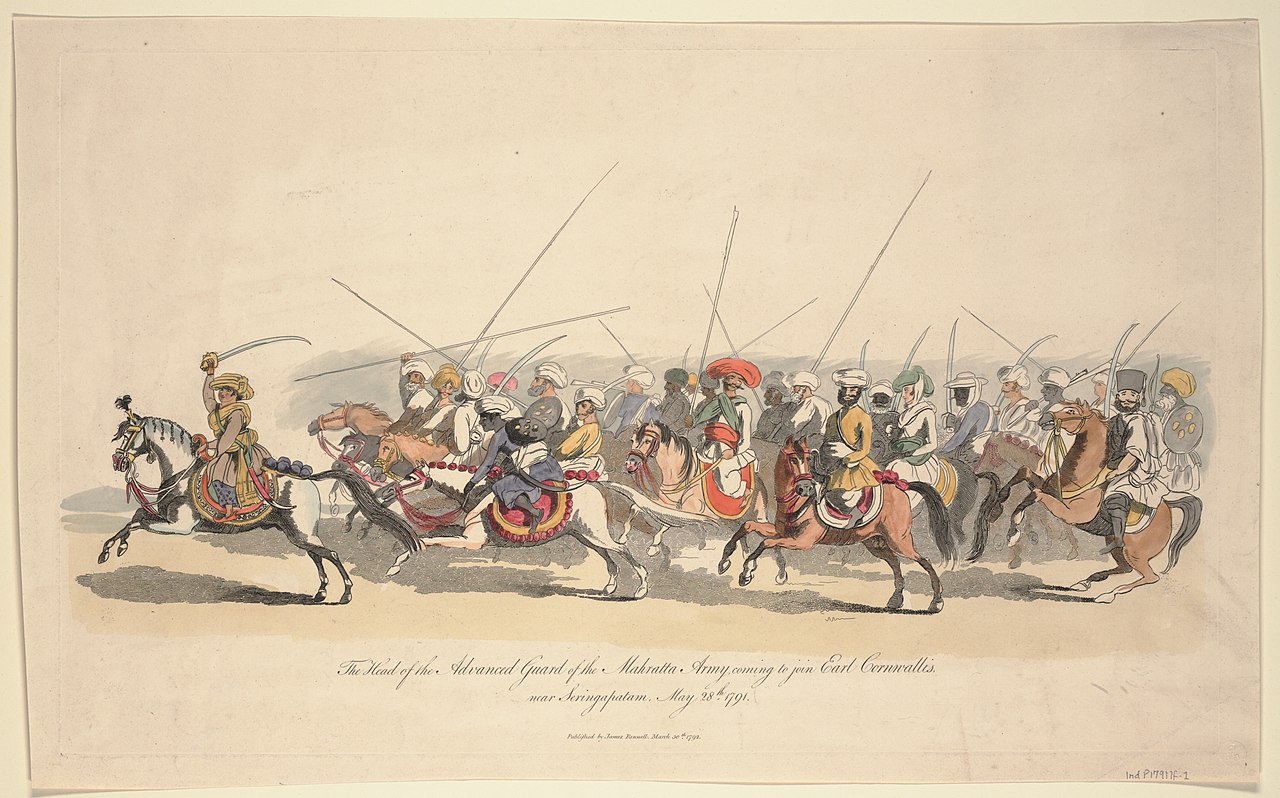
The cavalry Shivaji developed — the bargir and siledhar horse — was similarly configured for speed over mass. Maratha horsemen of this period carried little armour and rode light, fast horses bred for the Deccan plateau rather than the heavier mounts favoured by Mughal heavy cavalry. Their tactical role was not to deliver shock on the battlefield but to conduct rapid raids, disrupt enemy logistics, screen infantry movements, and pursue broken enemies. They were, in modern terminology, light cavalry used for strategic harassment rather than operational decision.
The operational method that emerged from these elements was what later analysts would call ganimi kava — the guerrilla way. Its principles, as Shivaji articulated and practised them, can be summarised with some precision. Avoid pitched battle except on ground of your own choosing. Strike enemy supply lines and isolated detachments rather than main forces. Use the fort network to deny the enemy the ability to bring superior force to bear at a decisive point. Disperse when pursued; concentrate when the enemy disperses. Exhaust and demoralise through constant small actions rather than seeking single decisive engagement.
Shivaji understood something that many commanders never grasp: the goal of strategy is not to win battles but to make the enemy’s position untenable. Battles are merely one instrument toward that end, and not always the most efficient one.
The effectiveness of this doctrine was demonstrated most dramatically in the campaigns against Aurangzeb’s Deccan operations in the 1660s and 1670s. Mughal forces consistently outnumbered Maratha armies by large margins and consistently failed to achieve decisive results. The sack of Surat in 1664 and 1670 showed that Shivaji could project power offensively even against well-defended targets; the escape from Agra in 1666 demonstrated the intelligence and deception capabilities that were integral to the system. The Mughal Empire could occupy Maratha territory temporarily but could not hold it. The cost of sustained operations in the Deccan became a permanent drain on imperial resources — exactly the strategic outcome Shivaji’s doctrine was designed to produce.
There were, of course, limits to this system. It was optimised for survival and resistance, not for the projection of imperial power. It could not easily take and hold open country far from the Ghats. It was vulnerable to political fragmentation — the fort network and the distributed command structure required exceptional personal authority to coordinate, and that authority was difficult to institutionalise. These limits would become apparent in the generation after Shivaji’s death, as his successors struggled to manage both Mughal pressure and internal succession conflicts simultaneously.
II. The Cavalry Arc: Baji Rao I and the Age of Strategic Expansion
The twenty-seven-year war that Aurangzeb fought in the Deccan from 1681 until his death in 1707 exhausted the Mughal Empire without destroying the Marathas. The emperor who had arrived with the largest army ever assembled in India departed having accomplished none of his strategic objectives. The Maratha state survived, battered and fragmented, but intact in its essential structure. And in the decades following Aurangzeb’s death, as Mughal imperial authority disintegrated across the subcontinent, a new strategic opportunity opened for Maratha expansion that bore no resemblance to the defensive guerrilla campaigns of the founding era.
The figure who grasped this opportunity most completely was Peshwa Baji Rao I, who served as chief minister of the Maratha state from 1720 until his death in 1740. Baji Rao is, by any serious assessment, one of the most gifted operational commanders in Indian military history. He fought forty-one major engagements in his career and lost none. But his significance extends beyond individual battlefield success. He transformed the Maratha military from a regional defensive force into a continental offensive instrument — and the vehicle for that transformation was cavalry.
The strategic context demanded a different kind of warfare than the Sahyadri hills had produced. The Mughal successor states that emerged after 1707 — Hyderabad, Bengal, Awadh, the Rajput kingdoms — controlled vast territories in the Gangetic plains and central India. These territories were flat, open, and unsuited to the fort-based guerrilla doctrine. Seizing revenue rights, extracting tribute, and projecting political authority across this geography required forces that could move faster than any opponent could concentrate against them and could strike before defenders had time to organise resistance.
Baji Rao’s cavalry armies were engineered for exactly this purpose. His forces dispensed almost entirely with supply trains — the logistical apparatus that slowed conventional armies of the period to fifteen or twenty miles per day. Maratha horsemen under Baji Rao carried minimal equipment, sourced fodder and provisions from the country they passed through, and could sustain march rates of fifty to sixty miles per day that left opposing commanders unable to predict their axis of advance or concentrate forces in time to meet them. This was not raiding; it was a fully developed operational method for projecting decisive force at strategic distances.
Baji Rao’s approach anticipated what Liddell Hart would later call the indirect approach by two centuries. His campaigns consistently avoided the enemy’s centre of gravity and instead struck at the points — supply lines, political capitals, revenue territories — that made the enemy’s position strategically untenable.
The Delhi raid of 1737 stands as the apotheosis of this method. Baji Rao moved a Maratha force from the Deccan to the outskirts of the Mughal capital in a march of extraordinary speed, bypassing the Mughal army commanded by Khan Dauran and appearing before Delhi before any effective defence could be organised. The raid was not intended to capture and hold the city — Baji Rao had neither the siege equipment nor the political infrastructure for permanent occupation. Its purpose was to demonstrate, conclusively and publicly, that the Mughal Empire could not protect its own capital. The political consequences were proportionate to the demonstration: Mughal authority in central India collapsed, and Maratha tributary rights extended across vast new territories.
The battle of Bhopal in 1738, fought shortly after the Delhi raid, illustrates the other dimension of Baji Rao’s operational genius. Facing a combined Mughal-Nizam force that outnumbered his cavalry significantly and included artillery and war elephants, Baji Rao refused to accept the conventional pitched battle his opponents sought. He instead used the mobility advantage of his cavalry to manoeuvre around the enemy flanks, cut their supply lines, and force a strategic retreat without the costly frontal assault that the terrain and force balance would have made prohibitively expensive. The enemy army dissolved without a decisive engagement. It was, in miniature, the Deccan doctrine applied to open-country warfare at continental scale.
Yet the very success of this expansion created structural tensions that Baji Rao’s successors would find increasingly difficult to manage. As Maratha territorial control expanded from Maharashtra to Bengal to the Punjab, the administrative and military demands of governing a subcontinental empire began to diverge sharply from the lean, mobile, raiding-optimised force that had built it. Revenue collection required permanent garrisons. Permanent garrisons required infantry. Infantry required supply trains. Supply trains negated the mobility advantage. The Maratha military was being pulled, by the logic of imperial success, toward the kind of conventional army structure that its entire strategic heritage was designed to avoid.
III. The Fatal Transformation: Panipat and the Limits of Adaptation
The third Maratha-Afghan War, culminating in the Battle of Panipat on 14 January 1761, represents the most consequential military event in eighteenth-century Indian history. Its outcome — the near-annihilation of the Maratha army by Ahmad Shah Durrani’s Afghan forces — has been analysed exhaustively, but its strategic significance is still sometimes misread as a simple defeat in battle rather than what it actually was: the catastrophic failure of a military system that had drifted irrecoverably from its foundational principles.
The Maratha force that marched north to confront the Durrani invasion in 1760 was, in composition and doctrine, almost unrecognisable from the armies of either Shivaji or Baji Rao. Under the command of Vishwasrao and Sadashivrao Bhau, the Marathas had assembled a large conventional army: heavy infantry, siege artillery, war elephants, a vast supply train, and a camp following estimated at over two hundred thousand non-combatants. This was not, in the abstract, an irrational choice. The campaign’s objectives — driving the Afghans out of Delhi and restoring Mughal client arrangements — seemed to demand the kind of force that could hold territory and conduct siege operations.
But the conventional army structure imposed constraints that proved fatal. The enormous supply train reduced the force’s operational mobility to a fraction of what Maratha cavalry armies had historically achieved. The camp followers had to be fed. The artillery had to be moved. The result was that the Marathas found themselves manoeuvring at Afghan pace rather than Maratha pace, unable to use the speed and dispersion that had historically been their decisive advantage. When Durrani chose to accept battle at Panipat, the Marathas had no effective counter.
Panipat was not lost on the battlefield. It was lost in the months before the battle, when the Maratha army allowed itself to be shaped by its own supply requirements into exactly the kind of force that could be decisively defeated by a superior conventional enemy.
The battle itself unfolded with grim predictability once the strategic errors were made. Durrani used his Afghan cavalry to envelop the Maratha flanks while his artillery engaged frontally. The Maratha artillery — technically competent but tactically misemployed — could not compensate for the cavalry disadvantage that the supply-train-constrained force structure had created. Vishwasrao was killed early in the engagement. The army, denied its senior command and unable to manoeuvre, disintegrated. The losses were catastrophic: estimates of Maratha dead range from thirty to fifty thousand, including many of the confederacy’s finest commanders and most experienced soldiers. An entire generation of Maratha military leadership was effectively destroyed in a single afternoon.
The political consequences were proportionate to the military ones. Maratha authority in northern India collapsed. The tributary system that Baji Rao’s campaigns had built over two decades was dismantled within months. The confederacy itself — the loose alliance of Maratha houses under Peshwa authority — began the process of fragmentation that would ultimately render it incapable of offering coordinated resistance to British expansion.
IV. Reform and Resistance: De Boigne, Perron, and the European Interlude
The decades following Panipat produced a remarkable, if ultimately futile, attempt to rebuild Maratha military power on European foundations. The instrument of this attempt was the brigade system — battalions of disciplined infantry, trained and commanded by European officers, equipped with standardised muskets and field artillery, organised along the lines of contemporary European armies. The architects of this system were mercenaries: Benoit de Boigne, a Savoyard soldier of fortune who built Mahadji Scindia’s army in the 1780s and 1790s, and Pierre Cuillier-Perron, who succeeded him.
The results, in the narrow military sense, were initially impressive. De Boigne’s brigades inflicted significant defeats on Rajput and Mughal opponents, demonstrating that disciplined European-style infantry could operate effectively in Indian conditions. Mahadji Scindia, under whom these forces served, became the most powerful figure in northern Indian politics in the decade before his death in 1794, exercising effective control over the residual Mughal court in Delhi. The brigade system appeared to offer a path toward the kind of military modernisation that might allow the Marathas to compete with the expanding British presence.
The fundamental weakness of the brigade system was not technical but institutional. European-style armies required European-style states: centralised revenue collection, professional officer corps, standardised logistics, and consistent political direction. The Maratha confederacy, by its very nature, could provide none of these reliably.
The limitations became apparent in the Second Anglo-Maratha War of 1803–05. The battles of Assaye and Laswari, fought within six weeks of each other in September and November 1803, demonstrated both the achievements and the fatal constraints of the reformed Maratha military. At Assaye, Arthur Wellesley — the future Duke of Wellington — attacked a combined Scindia-Bhonsle force that possessed artillery superiority and occupied a strong defensive position. Wellesley’s assault was costly: his forces suffered some of the heaviest casualties, proportionally, of any engagement in his career. He later described Assaye as the hardest fighting he had ever witnessed. The Maratha artillery, trained and served largely by European gunners, performed with professional competence.
And yet the battle was lost. The reason illustrates the fundamental strategic weakness of the reformed Maratha system. European-style warfare required not merely European-style troops but European-style command — unified, hierarchical, capable of rapid tactical adjustment. The Maratha confederacy, politically fragmented and militarily commanded by a combination of European mercenaries and Indian sardars with competing loyalties, could not provide this. When the Maratha infantry broke under pressure at Assaye, there was no coordinated response. The cavalry, which might have screened a withdrawal or delivered a counterstroke, was not effectively employed. The army disintegrated as an organised force even though individual units had fought well.
Laswari, fought six weeks later against Perron’s former brigades now commanded by Louis Bourquin, produced a similar result for similar reasons. The infantry — abandoned by cavalry and without coordinated leadership — fought to near-annihilation but could not convert tactical resistance into operational survival. By the end of 1803, the military capacity of the northern Maratha powers had been effectively destroyed.
V. The Final Reckoning: Why the Maratha Military Failed
The Third Anglo-Maratha War of 1817–19 was less a military contest than a political dissolution. The remaining Maratha powers — the Peshwa at Pune, the Bhonsles at Nagpur, the Holkars at Indore — had never recovered cohesion after 1803. They fought separately, were defeated separately, and were absorbed into the British Indian empire separately. The military dimension of the final war was characterised by engagements at Kirkee, Sitabuldi, and Mahidpur that displayed competent British combined-arms tactics against Maratha forces that were neither large enough, unified enough, nor doctrinally coherent enough to offer effective resistance.
The question of why the Maratha military ultimately failed admits several levels of analysis. At the most immediate level, the answer is institutional: the confederacy’s political structure was incompatible with the demands of modern military organisation. Centralised command, standardised logistics, professional officer development, and consistent strategic direction all required a degree of political unity that the Maratha system, built on the competing autonomy of multiple houses, could never achieve for long enough to matter.
At a deeper level, however, the failure reflects a genuine strategic tragedy. The Marathas possessed, in their foundational guerrilla doctrine, a military system of real sophistication that was well-matched to the political and geographic realities of the Deccan. They abandoned it — not through ignorance but through the inescapable logic of imperial expansion — in favour of conventional military forms that their state structure could not adequately support. The attempt to fight like a European power without the institutional infrastructure of a European state produced an army that had lost the asymmetric advantages of the original system without acquiring the centralised capabilities of the model it was attempting to emulate.
The Maratha military story is ultimately a cautionary tale about the dangers of strategic imitation. The guerrilla cannot become a conventional great power simply by adopting the outward forms of conventional military organisation. The institutional depth must precede the military ambition — and in the Maratha case, it never did.
There is a final irony worth noting. The British forces that defeated the Marathas in their conventional phase were themselves, in certain respects, employing doctrinal principles that bore a closer resemblance to the Maratha guerrilla tradition than to European linear warfare. Wellesley’s Deccan campaigns were characterised by extraordinary attention to logistics, careful use of terrain, avoidance of unnecessary frontal assault, and a willingness to manoeuvre for positional advantage rather than seek the decisive battle at all costs. He had learned, in part, from studying his opponents. The principles that Shivaji had developed to survive against the Mughals were, in their essentials, sound. The tragedy of the Maratha military is that its heirs forgot them.
The arc from Shivaji’s mountain forts to the final surrender of the Peshwa in 1818 spans one hundred and forty years and encompasses some of the most consequential military innovation in South Asian history. The Maratha military tradition produced commanders of genuine brilliance, doctrinal concepts of lasting analytical interest, and moments of collective endurance that merit serious study. Its ultimate failure should not obscure the scale of what it achieved — nor the clarity with which it illustrates the permanent tension, in military history, between the genius of asymmetric warfare and the temptation of conventional power.
