I. The Weight of Numbers — What the Eastern Front Actually Was
Any serious analysis of the Second World War must begin with the numbers — because the numbers alone establish the Eastern Front's primacy with a force that no argument need supplement.
The Eastern Front — The Scale of the Conflict
These numbers require a moment of genuine contemplation. Twenty-seven million Soviet dead. To put that in perspective: the United States lost approximately 420,000 in the entire war across all theatres. Britain lost approximately 450,000. France, including the Resistance and colonial forces, lost approximately 600,000. The Soviet Union lost more people in the siege of Leningrad alone — approximately one million civilians — than the United States and Britain combined lost in the entire conflict.
The German military's experience mirrors this asymmetry. Of the approximately 5.5 million German military deaths in the war, roughly 75 to 80 percent occurred on the Eastern Front. The Western Front — from D-Day on June 6, 1944 to Germany's surrender on May 8, 1945 — accounted for perhaps 20 to 25 percent of German military casualties. The war against the Western Allies was, by this measure, a secondary conflict that Germany conducted with forces it could spare from the existential struggle in the East.
II. Operation Barbarossa — The War That Mattered
When Germany invaded the Soviet Union on June 22, 1941, it committed the largest military force in the history of warfare to a single operation. Operation Barbarossa involved approximately 3.8 million Axis troops — Germans, Romanians, Hungarians, Italians, Finns — advancing across a front that stretched from the Arctic to the Black Sea. It was the decisive gamble of the entire war: Hitler's conviction that the destruction of the Soviet Union would give Germany control of the continent's resources — the Ukrainian wheat, the Caucasian oil, the Ural minerals — and make it permanently invulnerable to blockade or attrition.
The initial German advance was breathtaking in its speed and devastation. By December 1941, German forces had advanced to within sight of Moscow's spires, had encircled and destroyed Soviet armies in battles of encirclement — Kesselschlachten — of a scale previously unimagined in warfare, and had captured or killed more than three million Soviet soldiers. By any conventional military calculus, the Soviet Union should have collapsed.
We have only to kick in the door, and the whole rotten structure will come crashing down.
— Adolf Hitler, June 1941, on the eve of Operation BarbarossaThat it did not collapse — that the Soviet state survived the catastrophe of 1941, reconstituted its armies, and began the long, grinding counteroffensive that would end in Berlin — is the central fact of the Second World War. Everything else is secondary to this fact. D-Day was possible only because the Soviet Union had already broken the back of the Wehrmacht in three years of warfare that the Western Allies watched from the sidelines.
III. Stalingrad — The Hinge of the War
If one is compelled to identify a single battle as the turning point of the Second World War, it is not El Alamein, not D-Day, not the Battle of the Bulge. It is Stalingrad — the five-month struggle for a city on the Volga that consumed the German Sixth Army and permanently altered the strategic balance of the war.
The Battle of Stalingrad lasted from August 1942 to February 1943. At its peak, the city was reduced to rubble and the fighting descended to a level of close-quarters savagery — building by building, floor by floor, room by room — that the German military called Rattenkrieg: rat war. Soviet snipers, factory workers, and women's anti-aircraft units held the western bank of the Volga while the Red Army assembled the forces for the encirclement operation — codenamed Operation Uranus — that would trap the German Sixth Army.
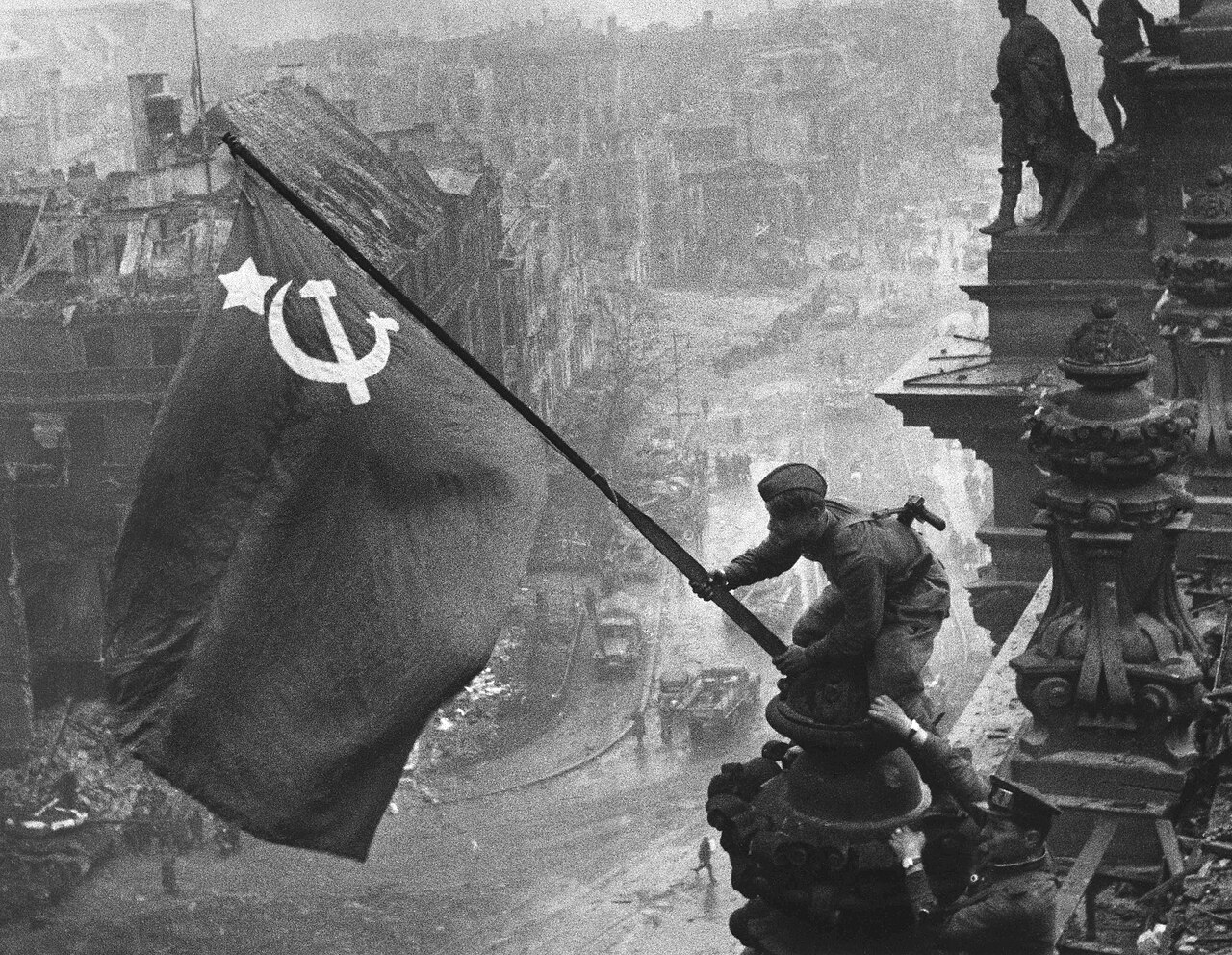
On November 19, 1942, Soviet forces launched Uranus — a massive double envelopment that broke through the Romanian armies on the Sixth Army's flanks and closed a ring around 300,000 German and Axis soldiers. Field Marshal Friedrich Paulus, commanding the Sixth Army, requested permission to break out. Hitler refused. On February 2, 1943, the remnants of the Sixth Army — 91,000 survivors, including 24 generals and Paulus himself, newly promoted to Field Marshal — surrendered.
The God of War has gone over to the other side.
— Field Marshal Erich von Manstein, after Stalingrad, 1943Stalingrad's significance was not merely military. It shattered the myth of German invincibility that had sustained the Nazi war effort and the submission of occupied Europe. For the first time, a large German formation had been not merely defeated but destroyed — surrounded, starved, and forced into a surrender that Hitler had declared impossible. The psychological impact on both sides was enormous and irreversible. After Stalingrad, the question was no longer whether Germany would lose the war in the East. It was only when, and at what cost.
IV. Kursk — The Death of the Panzer Arm
If Stalingrad was the psychological turning point, Kursk — the massive armoured clash of July 1943 — was the operational one. The Battle of Kursk remains the largest tank battle in history, involving approximately 6,000 tanks, 4,000 aircraft, and two million soldiers on both sides. It was Germany's last strategic offensive on the Eastern Front — the attempt to pinch off a Soviet salient near Kursk and restore the initiative that Stalingrad had surrendered.
The Soviets, forewarned by intelligence from the Lucy spy ring and their own reconnaissance, prepared a defence in depth of extraordinary sophistication — eight defensive belts, thousands of anti-tank guns, hundreds of thousands of mines. When the German offensive — Operation Citadel — began on July 5, 1943, it ran directly into this prepared defence and was ground to pieces.
The armoured clash at Prokhorovka on July 12 — often described, somewhat inaccurately, as a single massive tank battle — saw the SS Panzer Corps suffer losses from which it never recovered. More importantly, the Soviet counter-offensive that followed Citadel's failure — Operations Kutuzov and Rumyantsev — demonstrated that the Red Army had now mastered the operational art of warfare at a level that matched and in some respects exceeded its German opponents. The initiative on the Eastern Front passed permanently to the Soviet side after Kursk. It never returned to Germany.
V. D-Day in Context — What Normandy Actually Achieved
To place D-Day in its proper historical context is not to diminish the courage of those who landed on Omaha, Utah, Gold, Juno, and Sword beaches on June 6, 1944. It is to understand what they were landing into — and what had already happened before they arrived.
By June 1944, the Eastern Front had been grinding for three years. The Wehrmacht had lost Stalingrad, Kursk, and the Dnieper line. Soviet forces had liberated Leningrad from its 872-day siege in January 1944. The Red Army was advancing across a broad front, liberating Ukrainian territory at a pace that reflected both its growing operational sophistication and the fundamental exhaustion of German defensive capacity.
On June 6, 1944 — D-Day — Germany had approximately 58 divisions in France and the Low Countries facing the Western Allies. On the Eastern Front, Germany had approximately 165 divisions facing the Red Army. The disproportion is stark: the Western Allies faced roughly one quarter of Germany's committed ground forces. The Soviet Union faced the other three quarters — and had been doing so for three years.
On D-Day, the Western Allies faced roughly one quarter of Germany's committed ground forces. The Soviet Union had been fighting the other three quarters for three years.
Moreover, the timing of D-Day was itself determined by the Eastern Front. The reason the Western Allies were able to land in Normandy with a reasonable prospect of success in June 1944 — rather than being thrown back into the sea, as had nearly happened at Anzio in January 1944 — was precisely because the Wehrmacht's best divisions, its most experienced commanders, and its most capable armoured forces were committed in the East. The Panzer divisions that might have destroyed the Normandy beachhead in its first forty-eight hours were instead deployed on the Russian steppe.
This is not a counterfactual speculation. It is the considered assessment of the German commanders themselves. Field Marshal Gerd von Rundstedt, commanding German forces in the West in 1944, repeatedly requested reinforcements from the Eastern Front and was repeatedly refused. The reason was simple: the Eastern Front could not spare them.
VI. The Soviet Industrial Achievement — The War Behind the War
The military victory on the Eastern Front was inseparable from an industrial achievement of comparable magnitude. When Germany invaded in June 1941, the Soviet leadership made the decision to dismantle entire factories — literally unbolting machinery from factory floors — and transport them by rail to the Urals and Siberia, beyond the reach of German forces. This relocation, accomplished under combat conditions with millions of workers following their factories east, was one of the most remarkable feats of economic mobilisation in history.1
By 1943, Soviet industrial production had not merely recovered from the catastrophic losses of 1941–42 — it had surpassed pre-war levels. In that year, the Soviet Union produced 24,000 tanks to Germany's 17,000; 35,000 aircraft to Germany's 25,000. The T-34 tank — technically superior to most German armour and produced in vastly greater numbers — became the instrument through which Soviet operational art translated into German defeat. The industrial war was won before the military war was decided, and it was won in the relocated factories of the Urals.
American Lend-Lease aid — approximately $11 billion in supplies including food, trucks, aircraft, and communications equipment — made a genuine contribution to Soviet survival and operational capacity, particularly in the desperate months of 1941–42. The Soviet leadership acknowledged this privately while minimising it publicly for political reasons. But Lend-Lease was a supplement to Soviet industrial capacity, not a substitute for it. The tanks, the artillery, the aircraft that won the war were overwhelmingly Soviet-built.
VII. Why the West Forgot — The Politics of Memory
If the Eastern Front was decisive, why has its centrality been so systematically marginalised in Western historical consciousness? The answer is not primarily historical — it is political.
The onset of the Cold War almost immediately after Germany's defeat created powerful incentives for the Western powers to reframe the narrative of the war. A war story in which the Soviet Union played the decisive role was politically inconvenient when the Soviet Union had become the primary adversary of the Western democracies. The liberation narrative — in which Anglo-American forces liberated Western Europe from Nazism — was both emotionally satisfying and politically functional. It positioned the Western powers as the war's heroes and obscured the uncomfortable reality that the war's outcome had been determined primarily by a totalitarian state whose methods and objectives were antithetical to the values it was credited with defending.2
The Soviet Union, for its own reasons, was equally selective in its war memory — emphasising the heroism of the Red Army while suppressing discussion of the catastrophes of 1941, the role of Lend-Lease, and the crimes committed by Soviet forces during their westward advance. Neither side had an interest in a fully honest reckoning with what had actually happened.
The result, in the Western world, was a war narrative centred on Dunkirk, the Battle of Britain, El Alamein, D-Day, and the liberation of the concentration camps — a narrative in which the Eastern Front appeared as a backdrop of vague enormity rather than the central theatre of the conflict. Films, television series, and popular histories reproduced this narrative with remarkable consistency, generation after generation.
VIII. Conclusion — Giving History Its Due
None of this analysis is intended to diminish the genuine courage and sacrifice of Western Allied forces, or to minimise the strategic importance of the North African, Italian, and Western European campaigns. The defeat of the U-boat campaign in the Atlantic was essential to Allied supply lines. The strategic bombing campaign — for all its moral complexity and contested effectiveness — tied down significant German resources. The liberation of Western Europe had consequences for the post-war political order that reverberate to the present day.
But the war against Nazi Germany was won primarily on the Eastern Front, by the Soviet Union, at a cost in human life that the Western world has never fully reckoned with or adequately commemorated. The decisive battles were Stalingrad and Kursk, not El Alamein and Normandy. The decisive industrial achievement was the relocation and expansion of Soviet industry, not American Lend-Lease. The decisive strategic commitment was the Red Army's four-year struggle against 75 to 80 percent of Germany's combat power — not the Western Allied campaign against the remaining fraction.
D-Day was a necessary operation that opened a second front at a moment when Germany was already being ground down in the East. It was brilliantly planned, courageously executed, and strategically significant. It was not where the war was decided.
The war was decided in the snow outside Moscow in December 1941, when Soviet forces launched their first successful counteroffensive and proved that Germany could be stopped. It was decided in the ruins of Stalingrad in February 1943, when an entire German army surrendered for the first time in the war. It was decided in the burning fields of Kursk in July 1943, when Germany's last offensive capacity in the East was destroyed.
To understand the Second World War is to understand the Eastern Front. Everything else, however important, is context.
Notes & References
- Mark Harrison, The Economics of World War II: Six Great Powers in International Comparison (Cambridge: Cambridge University Press, 1998). The standard quantitative study of comparative wartime economic mobilisation.
- Norman Davies, No Simple Victory: World War II in Europe, 1939–1945 (London: Viking, 2006). Davies is among the most forceful advocates for recentring the Eastern Front in the history of the war.
- David Glantz and Jonathan House, When Titans Clashed: How the Red Army Stopped Hitler (Lawrence: University Press of Kansas, 1995). The definitive operational history of the Soviet-German war in English.
- Antony Beevor, Stalingrad (London: Viking, 1998). The most widely read account of the battle in English.
- Richard Overy, Russia's War (London: Allen Lane, 1998). An outstanding synthesis of the Soviet war experience and its historical significance.