In the year 1336, on the banks of the Tungabhadra river in the rocky Deccan heartland, two brothers made a decision that would alter the course of southern Indian history. Harihara and Bukka, sons of Sangama, founded a city they called Vijayanagara — the City of Victory. The name had the quality of a declaration, perhaps even of defiance, because the age they lived in had not been conspicuously victorious for the people they were trying to protect. The Delhi Sultanate had swept south. The Hoysala kingdom was in its death throes. The Kakatiya dynasty of Warangal had fallen to Malik Kafur’s devastating raids. Temple after temple had been sacked, their consecrated images smashed, their accumulated wealth plundered. What Harihara and Bukka were founding was not merely a new kingdom. They were founding a redoubt.
For two hundred and thirty years, that redoubt held. From 1336 to the catastrophe at Talikota in 1565, Vijayanagara stood as the largest and most powerful Hindu kingdom in the subcontinent, a counterweight to the Deccan Sultanates, a refuge for scholars and artists and temple traditions driven south by the destruction in the north, and — most fundamentally — a civilisational ark that preserved and transmitted a way of life that might otherwise have been extinguished entirely south of the Vindhyas. What happened at Talikota ended the empire. What happened in the two centuries before it is one of the extraordinary stories of human resilience in the face of sustained civilisational pressure.
The World That Made Vijayanagara
To understand why Vijayanagara mattered, you have to understand what the Deccan looked like in the decades before its founding. The thirteenth and early fourteenth centuries had been a period of catastrophic disruption for the Hindu kingdoms of the south. Alauddin Khalji’s general Malik Kafur had conducted three major campaigns into the Deccan between 1303 and 1311, reaching as far as Madurai. These were not merely military campaigns in the conventional sense — they were raids of deliberate destruction, with temples explicitly targeted for demolition and the removal of their idols. The Hoysalesvara temple at Halebidu was sacked twice. The great Shiva temple at Chidambaram was attacked. The accumulated sacred geography of the south, built over centuries of royal patronage and popular devotion, was being systematically violated.
The ideological dimension of this destruction was explicit. The Sultanate’s chroniclers recorded it with pride. Ziauddin Barani, writing of Alauddin’s campaigns, celebrated the smashing of idols and the humiliation of the kafir as acts of religious merit. This was not merely incidental to the military and economic objectives of the campaigns — it was a stated purpose. The intent was not simply conquest but transformation: to convert the sacred landscape of the south into something that reflected the dominance of the new order.
The Vijayanagara kings understood themselves not merely as rulers but as guardians. Their royal titles said so explicitly: they called themselves Hindu Suratrana — Sultans among Hindus — and Gobrahmana Pratipalaka — protectors of cows and Brahmins. The language was not incidental. It was a statement of purpose.
It was into this world that Harihara and Bukka stepped. The traditional account, preserved in multiple sources, records that the two brothers had been captured by Muhammad bin Tughluq and taken to Delhi, where they converted to Islam and were later sent back south as governors. On returning to the Deccan, they reconverted to Hinduism under the guidance of the sage Vidyaranya — one of the great figures of Advaita Vedanta and later the Shankaracharya of the Sringeri Math — and proceeded to found their kingdom. Whether every detail of this account is accurate is a matter of scholarly debate. What is not in dispute is that the new kingdom positioned itself, from its very inception, as the defender of a civilisation under siege.
The City on the Tungabhadra
The site chosen for the capital was not accidental. The Tungabhadra river at Hampi flows through a landscape of extraordinary geological drama — massive granite boulders, some the size of buildings, scattered across the terrain as though thrown down by giants. The landscape was naturally defensive, the boulders providing both cover and commanding heights. The river itself formed a natural barrier to the north. The Vijayanagara builders used the terrain with extraordinary intelligence, incorporating the boulders into the city’s fortification walls, building temples inside caves and in the shadows of giant rocks, creating a city that seemed to grow organically from the land rather than being imposed upon it.
At its height, Vijayanagara was among the largest cities in the world. Contemporary travellers — the Portuguese Domingo Paes, the Persian Abd al-Razzaq, the Italian Nicolo Conti — wrote accounts that strained their capacity for superlatives. Abd al-Razzaq, who visited in 1443 during the reign of Devaraya II, described a city of incomparable beauty, its streets full of merchandise from across the known world, its markets selling precious stones by the basketful, its population so dense and its buildings so numerous that he could not find words adequate to the spectacle. Domingo Paes, writing in the early sixteenth century, said flatly that Vijayanagara was as large as Rome and that he saw within it many palaces and great edifices and many streets of the most beautiful kind.
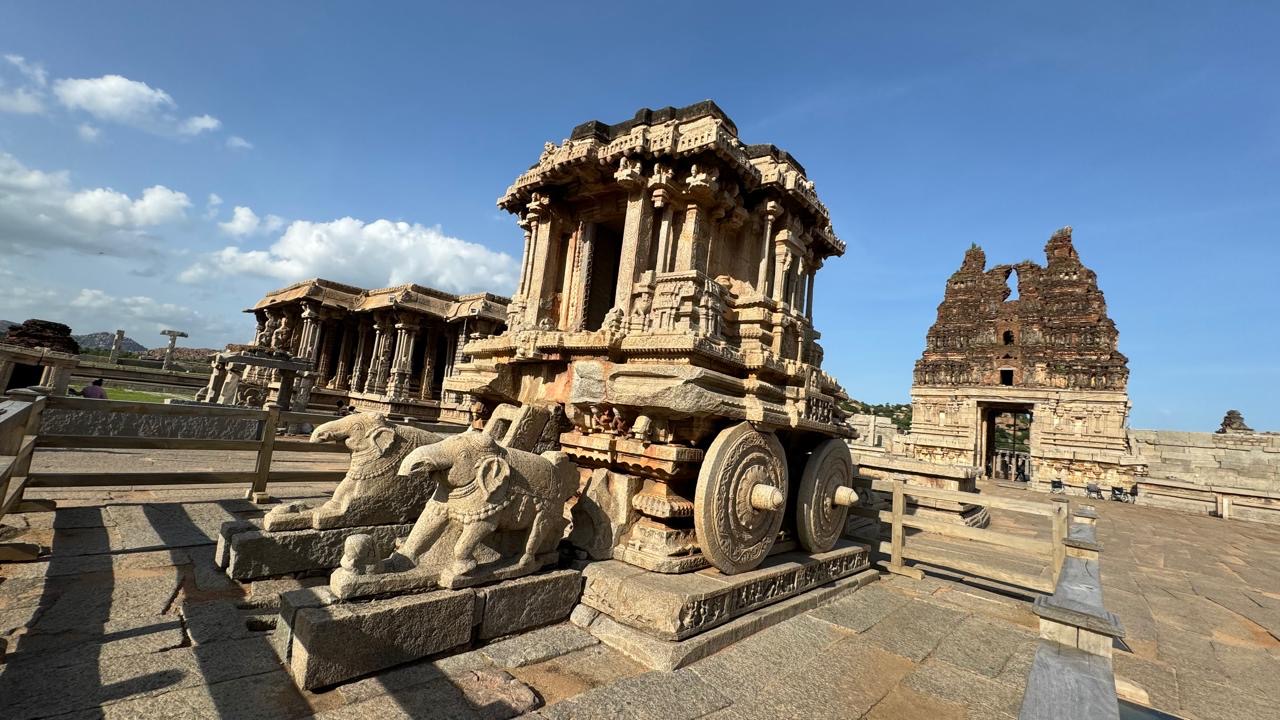
The city was not merely large. It was deliberately, ostentatiously magnificent — a statement to the world, and particularly to the Sultanates to the north, that the civilisation they had tried to destroy was not only alive but thriving. The great temple complexes of Hampi — the Virupaksha temple, the Vittala temple with its famous stone chariot and musical pillars, the Hazara Rama temple with its exquisitely carved panels of the Ramayana — were not simply places of worship. They were assertions. They said: we are still here. We are building. We endure.
The Sangama and Saluva Dynasties
The empire’s first dynasty, the Sangamas, produced a series of capable kings who steadily expanded their territory while managing the complex politics of the Deccan. Harihara I consolidated the initial gains and brought much of modern Karnataka under Vijayanagara control. His brother Bukka I, who succeeded him, was perhaps the more formidable of the two — a warrior and diplomat who extended Vijayanagara’s reach into Tamil Nadu and held the northern frontier against the Bahmani Sultanate, which had been founded in 1347 and would remain Vijayanagara’s primary adversary for much of the empire’s history.
Devaraya II, who ruled from 1424 to 1446, was the Sangama dynasty’s greatest king before the Tuluvas. He campaigned extensively in the south, bringing Orissa and the Deccan further into the empire’s orbit, and was known for his personal intellectual curiosity — Abd al-Razzaq’s visit to his court produced one of the most vivid accounts of Vijayanagara at its peak. Devaraya II made a significant and controversial military decision: he incorporated Muslim cavalry archers into the Vijayanagara army, recognising that the Bahmani Sultanate’s superiority in cavalry was a structural military disadvantage that had to be addressed. This pragmatism — the willingness to adopt what worked regardless of its origin — was characteristic of Vijayanagara’s approach to statecraft. The empire was a defender of Hindu civilisation, but it was not a rigid or exclusionary one. It traded with Muslim merchants, employed Muslim soldiers, and maintained diplomatic relations with the Sultanates even while fighting them.
The Sangama dynasty ended not with a foreign invasion but with internal weakness — a pattern that would repeat at the empire’s final end. A capable general named Saluva Narasimha effectively took power in 1485, founding the short-lived Saluva dynasty. The Saluvas were transitional rulers, consolidating the empire against internal fragmentation, but their dynasty lasted only two generations before another general, Narasa Nayaka of the Tuluva family, seized control.
Krishnadevaraya: The Sun at Its Zenith
In 1509, Narasa Nayaka’s son Krishnadevaraya ascended the throne of Vijayanagara, and the empire entered the most brilliant period of its existence. Krishnadevaraya ruled for twenty years, and in those twenty years he became something that very few rulers in any tradition manage to become: simultaneously the greatest military commander of his era, a patron of the arts on a scale that transformed the cultural landscape of the south, a poet of genuine distinction in his own right, and a figure of such personal charisma and political intelligence that the memory of him has never fully faded from the consciousness of the Telugu and Kannada peoples.
His military record was extraordinary by any standard. He defeated the Bijapur Sultanate at the battle of Diwani in 1512, capturing Raichur — a strategic fortress that had been a point of contention with the Deccan Sultanates for decades — in 1520 in one of the most decisive engagements of the era. He campaigned into Orissa, defeating the Gajapati king and extracting territorial concessions. He defeated the Bahmani Sultanate’s successor states repeatedly and comprehensively. At the height of his power, Vijayanagara’s territory stretched from the Krishna river in the north to the southernmost tip of the subcontinent, and from the Bay of Bengal to the Arabian Sea.
Krishnadevaraya was not merely a king who happened to write poetry. He was a poet-king in the deep sense — a ruler whose understanding of what his civilisation was and what it was worth was expressed as much through patronage and creation as through conquest. The two were, for him, inseparable.
The literary achievements of his reign were equally remarkable. He composed the Amuktamalyada in Telugu — a poem of remarkable sophistication that draws on the Vaishnava devotional tradition to explore themes of divine love and the proper relationship between a ruler and his people. He was the patron of the Ashtadiggajas, the eight celebrated poets of his court, of whom Allasani Peddana was considered the greatest. Under his patronage, Telugu literature reached a peak of refinement that it would not surpass for centuries. He also composed in Sanskrit and Kannada, and the breadth of his literary ambition reflects the breadth of the civilisational project he understood himself to be leading.
His temple construction and renovation programme was systematic and lavish. He rebuilt and expanded the Tirupati temple complex. He renovated temples across the south, commissioning the magnificent carved gopurams that still define the Tamil Nadu temple landscape. He understood that the temples were not merely religious sites but the visible, physical expression of the civilisation he was defending — and that their magnificence was itself a form of statement, a counter-declaration to the destruction that had been visited on similar structures to the north.
The Portuguese, who had established themselves on the Malabar Coast and were eager for an alliance against the common enemy of the Muslim Deccan Sultanates, maintained warm relations with Krishnadevaraya’s court. The Vijayanagara state imported horses from the Portuguese — the empire had no good horse-breeding territory and was perpetually dependent on imported cavalry horses, a structural vulnerability — and the Portuguese appreciated the stability and sophistication of the Vijayanagara trading relationship. Domingo Paes wrote his celebrated account of the empire during Krishnadevaraya’s reign, and his admiration for the king is barely concealed in every line.
The Architecture of Defiance
To walk through the ruins of Hampi today — and they are ruins, deliberately and comprehensively ruined, as we shall see — is to encounter a civilisation that had a very clear sense of what it was building and why. The Vijayanagara architectural style is distinct from both the Chalukya and the Chola traditions it inherited, and from the Sultanate styles it coexisted with. It is an architecture of assertion: wide, elaborately carved gopurams rising to great heights; vast temple enclosures with multiple concentric walls; mandapas supported by columns carved with an extraordinary density of figurative detail. Every surface seems to insist on its own existence.
The Vittala temple complex, with its stone chariot of Garuda — the wheels of which were designed to actually rotate — and its hall of musical pillars that produce distinct tones when struck, represents a level of technical and artistic ambition that is difficult to account for purely in terms of religious function. These were not just temples. They were demonstrations — demonstrations of what a civilisation was capable of when it was given the freedom and the resources to express itself. There is something in the exuberance of Hampi’s sculpture, in the sheer profusion of detail, that reads like a civilisation working out its own abundance after a period of suppression. The Vijayanagara builders were making up for lost time, and they knew it.
The secular architecture was equally ambitious. The Lotus Mahal, the elephant stables, the queens’ bath, the stepped tanks — the city was a complete urban organism with sophisticated water management systems, market streets, administrative quarters, and residential zones. The archaeological survey of the Hampi area has revealed a city that at its peak may have housed between five hundred thousand and one million people, making it one of the most populous urban centres in the world in the fifteenth and sixteenth centuries.
The Seeds of Decline
Krishnadevaraya died in 1529, and with him went the irreplaceable combination of military genius, political intelligence, and personal authority that had held the empire together. His immediate successors — his half-brother Achyuta Deva Raya and then his nephew Sadashiva Raya — were weaker rulers, and the court factionalism that had been suppressed by Krishnadevaraya’s force of personality reasserted itself rapidly. The great nayakas — the regional governors who administered the vast empire on behalf of the crown — began operating with increasing autonomy, their loyalty to Vijayanagara becoming more nominal than real.
The real power after Krishnadevaraya’s death passed to a regent named Aliya Rama Raya, the son-in-law of Krishnadevaraya, who was a formidable political operator but a man whose strategy ultimately proved fatal. Rama Raya pursued a policy of playing the five Deccan Sultanates — Bijapur, Bidar, Berar, Ahmadnagar, and Golconda — against each other, intervening in their quarrels, shifting alliances opportunistically, and extracting territorial and financial concessions from whichever side he was currently supporting. The strategy worked brilliantly for two decades, and Rama Raya accumulated enormous personal power and wealth through it.
What he did not account for was the possibility that the Sultanates, despite their mutual hostilities, would unite against him. They had reason enough: Rama Raya’s interference in their affairs had become intolerable, his arrogance in their courts was legendary — he was reported to have treated Sultanate envoys with deliberate contempt — and each of them had individual grievances that his policy had created. In 1565, the four principal Sultanates set aside their differences and agreed to a joint campaign against Vijayanagara.
Talikota: The Afternoon That Ended an Empire
The armies met at Talikota, near the Krishna river, in January 1565. Rama Raya led the Vijayanagara forces in person, despite being in his late seventies or even eighties — accounts differ, but all agree that he was an old man commanding from an elephant. The Vijayanagara army was large, perhaps the largest the empire had ever fielded, and Rama Raya was initially confident. For a time, the battle seemed to be going in Vijayanagara’s favour.
Then the Muslim contingents of the Vijayanagara army defected to the Sultanate side. The precise circumstances of this defection are debated by historians, but the consequences were instantaneous and catastrophic. With a significant portion of his forces suddenly fighting against him, the Vijayanagara line collapsed. Rama Raya was captured and immediately beheaded — his head was mounted on a pike and displayed to demoralise the remaining Vijayanagara forces, which broke and fled. The rout was total.
The city of Vijayanagara was not merely defeated at Talikota. It was erased. For five months, the armies of the Deccan Sultanates systematically dismantled what had taken two centuries to build. What the armies left, time and neglect completed.
What followed was one of the most thorough acts of urban destruction in pre-modern history. The armies of the Sultanates entered Vijayanagara and proceeded to demolish it with methodical thoroughness. For five months — some accounts say six — the destruction continued. Temples were torn down, palaces were burned, the population was massacred or enslaved, and the accumulated wealth of two centuries of the most prosperous kingdom in southern India was carried north. Domingo Paes had described a city as large as Rome. What the Sultanate armies left behind was rubble.
The ruins at Hampi today are the ruins that those five months made. The great stone structures — the temples, the gopurams, the carved halls — survived because stone is harder to destroy than timber and plaster. But the organic city, the markets and houses and gardens that made Vijayanagara a living urban organism, vanished entirely. When the traveller Robert Sewell visited in the nineteenth century and wrote his famous account of the empire, he titled it A Forgotten Empire — because within two centuries of its fall, Vijayanagara had been so thoroughly erased that its very existence had passed from living memory to archaeological speculation.
The Legacy That Could Not Be Erased
Vijayanagara fell, but it did not die cleanly. The successor state at Penukonda, and later at Chandragiri and Vellore, maintained a vestigial Vijayanagara court for nearly a century after Talikota. More importantly, the great nayaka governors of Vijayanagara — particularly the Nayaks of Madurai, Thanjavur, and Ikkeri — became independent rulers in their own right and continued the tradition of temple patronage, literary culture, and Hindu statecraft that Vijayanagara had established. The Tamil and Telugu temple traditions of the seventeenth and eighteenth centuries — the great gopuram-building campaigns, the elaboration of classical music and dance, the continuation of Puranic literary culture — are in significant measure the inheritance of Vijayanagara transmitted through its successor states.
The Brihadeesvara temple at Thanjavur, the Meenakshi temple at Madurai, the great temple complexes of Srirangam and Tirupati in their current form — all of these bear the mark of Vijayanagara patronage, directly or through the nayaka successor states. When a visitor stands before the towering gopuram of the Meenakshi Amman temple, they are looking at an architectural tradition that Vijayanagara protected, sustained, and transmitted. The city may be rubble. The tradition is not.
There is also a deeper legacy that is harder to quantify but perhaps more important. Vijayanagara demonstrated, at a moment when it was not obvious that demonstration was possible, that a Hindu civilisation could organise itself into a state capable of defending its sacred geography, patronising its intellectual and artistic traditions, and competing with the most militarily sophisticated powers of its era over an extended period. It was not an inevitable success — it required extraordinary individuals at critical moments, and it was ultimately overcome by a coalition of enemies working together against it. But it lasted long enough, and built magnificently enough, that what it protected survived.
The question Vijayanagara answers is not whether civilisations can be defended. They can. The question it leaves open is whether they can be defended indefinitely against opponents who are willing to ally against them — and whether the internal divisions that brought Vijayanagara down are a peculiarity of that empire or an enduring feature of the political landscape it inhabited.
The stone chariot at Vittala temple still stands. Its wheels, designed to turn, were cemented in place by the Archaeological Survey of India to prevent damage — a small, unintended metaphor for the empire it commemorates. The motion was arrested. But the chariot is there, and the stone elephants that draw it still strain forward, still pulling toward a destination that the empire never quite reached, still magnificent in the afternoon light at Hampi, still refusing, in granite, to admit defeat.
