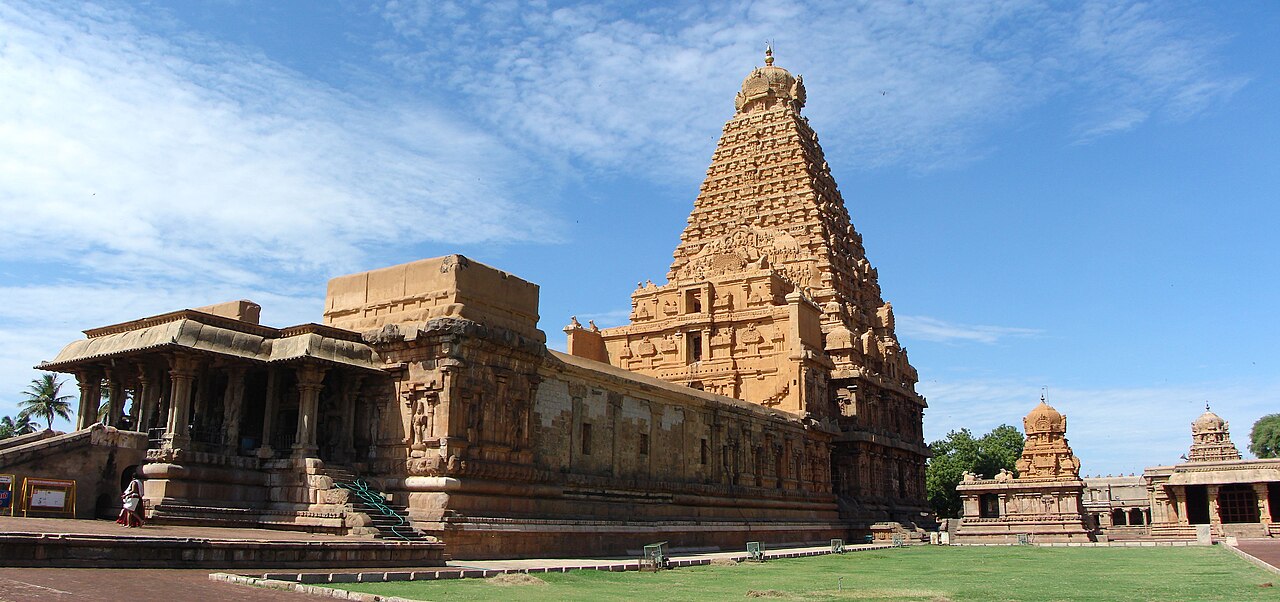
There is a conversation that happens, with small variations, in Tamil diaspora gatherings the world over. Someone will speak with pride about the Tamil language — its antiquity, its literature, its unbroken continuity across three millennia. Someone else will mention the food, the music, the classical dance forms, the silk and the jewellery and the particular quality of the festivals. The pride in the room is genuine and it is earned. Tamil civilisation is one of the oldest living traditions on earth, and those who carry it deserve to feel its weight and its beauty. But there is something that often goes unremarked in these conversations, an absence at the centre of the celebration, and if you look for it you will find it almost every time: the gods.
Not all Tamil people, of course. But enough. Enough that the silence is noticeable. Enough that you will find, in the same room where Thiruvalluvar is quoted and Bharatanatyam is celebrated and the Sangam poets are invoked, people for whom Murugan is a stranger — people who will enthusiastically claim Tamil heritage with one breath and say hallelujah with the next, apparently without registering any tension between the two. This essay is about that tension. It is about why the tension is real, why it matters, and why the comfortable modern habit of separating culture from faith is not a sophistication but a confusion.
What Culture Actually Is
The word culture comes from the Latin cultura, which derives from colere — to till, to cultivate, to tend. The agricultural metaphor is not accidental. Culture is what a people grows in a particular soil over a long period of time. It is the accumulated response of a community to its landscape, its climate, its history, its losses and its joys — the sediment of lived experience hardened into form. Language is culture. Food is culture. Music is culture. Art is culture. The particular way a community marks birth and death and marriage and harvest is culture.
And the gods are culture. This is not a metaphor or a romantic flourish. It is a structural observation about how human communities actually organise their lives and their meanings. The gods of a people are not an optional addition to their cultural identity, something that can be swapped out or upgraded while the rest remains intact. They are the axis around which everything else turns. The Tamil classical literature is saturated with Murugan, with Shiva, with the great mother goddess in her many forms. The architecture is saturated with them. The calendar is structured around them. The festivals, the rites of passage, the ethical vocabulary, the metaphysical assumptions about the nature of the self and its relationship to the cosmos — all of it flows from and returns to the gods. You cannot remove the gods from Tamil culture and still have Tamil culture. You have something else: a museum exhibit of Tamil culture, the husk without the living centre.
Culture is not a costume you can put on and take off. It is an inheritance, and like all inheritances it comes whole or it does not come at all.
This is worth stating plainly because the modern liberal consensus tends to disagree. The modern view, which has considerable force behind it, holds that individuals should be free to pick and choose from their cultural heritage — to take the language and leave the religion, to celebrate the festivals as cultural events stripped of their theological content, to claim an ethnic identity without the metaphysical commitments that identity was historically inseparable from. This view has the virtue of being tolerant and the vice of being shallow. It treats culture as a menu from which items can be selected individually, when in fact culture is more like an ecosystem — interconnected, mutually dependent, liable to collapse when key elements are removed.
What the World Has Lost
The erasure of indigenous gods is one of the most consistent and least mourned patterns in human history. We tend not to mourn it because the erasure, when it is complete, leaves no one behind who remembers what was lost. The Greeks who worshipped Zeus and Athena and Dionysus are gone. In their place are Greek Christians who have been Christian for so many centuries that the Olympian gods feel as foreign to them as they do to anyone else. The Norse who propitiated Odin and Thor before battle have been replaced by Scandinavian Christians and, later, by Scandinavian secularists for whom Thor is a comic book character. The Celts who kept sacred groves and worshipped at springs and venerated the otherworld in ways we can only partially reconstruct from the remnants the missionaries did not destroy — they are gone too, replaced by Irish Catholics and Welsh Methodists who are, in turn, proud of their Celtic heritage.
The pattern repeats across the Americas, Africa, the Pacific, Asia. Everywhere that the great missionary religions — Christianity and Islam, primarily — expanded, they encountered indigenous systems of meaning and worship and they worked, with varying degrees of violence and subtlety, to replace them. Sometimes the replacement was accomplished by force: the burning of temples and the smashing of idols and the execution of those who refused the new god. Sometimes it was accomplished by poverty, by the linking of material benefit to religious conversion, so that accepting the new faith was the price of the schooling and the medicine and the social advancement that the missionaries controlled. Sometimes it was accomplished by sustained cultural pressure over generations, so that the old ways came to seem primitive and embarrassing and the children of converts were ashamed of what their grandparents believed.
In each case, what was lost was not merely a set of religious beliefs. What was lost was the specific way a particular community of human beings had organised its relationship to existence — its particular answers to the questions of why we are here, how we should live, what we owe each other, what happens when we die, what the cosmos fundamentally is. These are not trivial questions. They are the most important questions human beings ask. And the answers a culture develops over centuries of living in a particular place, speaking a particular language, burying its particular dead — those answers are not interchangeable with the answers developed elsewhere. They belong to a place and a people in ways that are not easily transported.
When the gods of a people are replaced, the new gods do not fill the old space. They occupy it. Something that was alive becomes a dwelling for something foreign, and the original inhabitants are expected to be grateful for the renovation.
Greece is instructive here. Modern Greece is a country that is intensely proud of its ancient heritage — the philosophy, the architecture, the democracy, the literature. The Parthenon is the national symbol. Homer is taught in schools. Athens names its streets and squares after figures from antiquity. And yet the religious tradition that produced the Parthenon, that gave the Acropolis its meaning, that animated the tragedies of Sophocles and the dialogues of Plato — that tradition was destroyed. Not gently phased out. Destroyed. The temples were converted into churches. The festivals were abolished. The priests were killed or driven out. Theodosius I made paganism illegal in 391 CE and the state enforced the prohibition. Within a few generations, the gods that had defined Greek civilisation for a millennium were gone, and the people who had worshipped them were Christian.
Modern Greeks are Christian in a way that is now entirely natural to them — it is their inheritance, as much a part of their identity as the language. This is not in question. But when a modern Greek stands before the Parthenon and feels pride in its beauty, there is something slightly strange in the experience, something that is perhaps not consciously registered: this building was a house for a goddess who is no longer worshipped, built by a civilisation whose religious imagination has been comprehensively replaced. The pride in the cultural achievement is real. But it is pride in the husk.
And Greece is only the most visible case. The same replacement, with the same essential mechanics, happened across the whole of what is now called the West. Charlemagne offered the Saxons a choice between baptism and death, and when they refused, he had some four and a half thousand of them executed in a single day at Verden in 782 — a massacre, not a negotiation. Boniface felled Donar's Oak, sacred to Thor, in front of the people who worshipped there, specifically to demonstrate that their god could not stop him; when nothing happened, he used the timber to build a church on the same spot. Lithuania held out longer than anywhere else in Europe, and was only compelled into Christianity in 1387 — a conversion driven by dynastic politics and military pressure, arriving at almost exactly the same historical moment other proselytizing conquests were reaching other parts of the world. None of this was gentle. None of it was chosen in any meaningful sense by the people living through it. It was the same proselytizing replacement this essay has been describing, wearing different clothes, and it is worth being precise about that rather than letting the West quietly exempt itself from its own history.
The West is not an exception to this essay's argument. It is the argument, completed. What it shows is not that this transition can be made peacefully. It shows what total forgetting looks like once enough centuries have passed to disguise it as peace.
Why, then, does no tension remain? Why can a Norwegian be devoutly Lutheran and unselfconsciously proud of Viking heritage, in a way a Tamil convert often cannot manage with equivalent ease regarding Murugan? Two mechanisms are doing the actual work, and neither of them is reconciliation.
The first is simply that the wound has no one left to hurt. The tension this essay describes requires a person who is proud of a culture and also aware, at some level, that the faith which produced it remains genuinely available — a real fork still standing in the road. Once every last person capable of feeling that fork has died, the tension has no one left to occupy it. This is not resolution. It is exhaustion of the population that could have felt the conflict at all.
The second is sharper, and less often said plainly: a dead faith is safe to love, and a living one is a threat. Zeus and Thor can be taught fondly in primary schools, printed on shields and t-shirts, given starring roles in blockbuster films, precisely because they are confirmed extinct and can no longer draw a single soul away from anything. The moment a god is safely dead, that god graduates from rival to heritage. Murugan cannot yet receive this treatment from a missionary perspective, for the simple reason that Murugan is still, this year, receiving real offerings from real devotees on the hills of Tamil Nadu. The comfort the modern West feels toward its own extinguished gods is not evidence that losing a pantheon is harmless. It is evidence that a loss stops registering as loss once it is total and old enough — which is precisely why this essay's argument matters now, for a living tradition, rather than as an epitaph for a dead one.
There is a further asymmetry worth naming, because it cuts against a comfortable assumption that medieval Christianisation and modern conversion are simply the same story on different dates. Much of early medieval Europe's conversion proceeded by syncretism as much as by force: Christmas absorbed Yule rather than simply cancelling it; Easter's very name likely descends from Eostre, a Germanic dawn goddess; countless local saints quietly inherited the functions, and sometimes the shrines, of the local gods and spirits they replaced. The old religious impulse was not so much annihilated as relabelled and permitted to continue wearing new vestments. The evangelical and Pentecostal Christianity actively converting communities in Tamil Nadu, across Africa, and among Native American nations today is, by contrast, frequently and deliberately anti-syncretic — trained explicitly to name the old gods as demons to be renounced rather than customs to be absorbed. Measured this way, the conversions happening within living memory are, in a real sense, more total in what they demand than the ones that already finished in Europe centuries ago. The West got the gentler version of this process and still lost everything. That should not be reassuring to anyone watching the harder version unfold now.
It is worth noting, finally, that a handful of modern Westerners have begun to feel exactly the tension this essay is describing, which is itself the clearest evidence that the tension is real rather than a peculiarity of formerly colonised peoples. Asatru and the wider Heathenry revival, modern Hellenic reconstructionism, contemporary Druidry — these remain small, minority movements, but they exist precisely because some number of Norwegians, Englishmen, and Greeks have looked at their own inherited pride in Viking or Anglo-Saxon or Hellenic ancestry, sitting alongside a faith that is native to none of it, and found the gap large enough to try to close. That the closing movements are marginal in the West is not proof the tension is imaginary. It is proof of how old and how thoroughly finished the loss already is there — and a measure of how much is still genuinely at stake, right now, in Tamil Nadu, while the same question is still open.
The Right to Convert and the Cost of Conversion
Let me be clear about what this essay is not arguing. It is not arguing that people do not have the right to convert their religious faith. They do, and that right ought to be protected. It is not arguing that Christianity or Islam are without value or that the people who follow them are doing something wrong. They are not. It is not arguing for a return to any particular set of beliefs or a reversal of any historical process. History does not reverse.
What it is arguing is something more modest and more uncomfortable: that conversion has a cost, that the cost is cultural, and that it is dishonest to celebrate a culture while refusing to acknowledge what was surrendered for it to reach you in its current form. The dishonesty is not usually conscious. It is the dishonesty of inheritance — of benefiting from something without fully reckoning with its history. But it is a dishonesty nonetheless, and it becomes more acute when the person who is simultaneously claiming a cultural identity and having abandoned the gods of that culture insists that nothing of substance has been lost.
Something has been lost. In some cases, it was taken. In others, it was traded away for something that seemed, at the time, more valuable — social acceptance, material advancement, the comfort of belonging to a religion backed by imperial power. The transaction may have been rational given the circumstances. The loss is real regardless.
There is a particular form of this dishonesty that is worth naming directly: the person who is zealous in their new faith, who actively denigrates the old gods of their people as superstition or idolatry, and who simultaneously claims pride in their cultural heritage. This is not merely inconsistent. It is a kind of violence against the ancestors — against the people who built the temples, composed the hymns, organised their entire lives around the worship of those gods, and who would not recognise the person who claims their heritage while dismissing their deepest convictions as primitive. You cannot have both. You cannot call yourself proud of a civilisation while calling its sacred centre worthless.
India, Where the Gods Are Still Alive
What makes India unusual in this global picture is that the old gods are still here. In most of the world, the process of religious replacement is complete enough that the tension this essay is describing does not arise in any acute form. The Greeks have been Christian for sixteen centuries. There is no living tradition of Olympian worship to create friction with Greek cultural pride. The Norse gods exist only in sagas and scholarship. The Aztec gods are known only through archaeology and the records of the people who destroyed their worship.
In India, and particularly in the Tamil country, the gods that have been worshipped for three thousand years are still worshipped. Murugan still receives offerings on the hills of Tamil Nadu. Shiva still presides over temples built in the Dravidian style that the Pallavas and the Cholas raised. The festivals still happen. The priests still chant. The philosophical traditions that gave these gods their meaning — the Shaiva Siddhanta, the Vaishnavism of the Alvars, the great non-dual syntheses of Adi Shankaracharya — are still living, still debated, still practised. This is not a dead religion kept alive by scholarship. It is a living civilisation.
And alongside it, in the same cities, the same streets, sometimes the same families, are people who have converted — some centuries ago, some recently, some whose conversion was their own choice and some whose conversion was the work of colonial missionaries who offered schools and hospitals in exchange for souls. These people are, in many ways, Tamil. They speak Tamil. They eat Tamil food. They celebrate Tamil culture. They are proud, often genuinely and movingly proud, of the Tamil heritage.
But they do not worship the Tamil gods. They worship the god of a tradition that originated in the ancient Near East, that reached Tamil Nadu on Portuguese ships and in the wake of British administrators, that has its sacred texts in Hebrew and Greek and Latin, and that looks at the great Shiva temples of the south and sees, if it is being honest with itself, idolatry.
This is not a comfortable thing to say. It is true nonetheless. The question is not whether people have the right to make this choice. They do. The question is whether, having made it, they can still claim that nothing essential has been surrendered.
The Ram Question
There is a specific version of this argument that circulates in Tamil political and cultural discourse, and it deserves to be addressed directly because it is both widespread and, on examination, self-defeating. It goes like this: Ram is a northern god, an Aryan imposition, a symbol of Hindi cultural hegemony. Murugan is the true Tamil god, indigenous to the south, rooted in Tamil soil. Therefore the defence of Tamil cultural identity requires resistance to Ram and everything he represents, while the embrace of local Tamil tradition means the embrace of Murugan.
There is a grain of genuine cultural sentiment here, and it should not be dismissed entirely. The concern about northern cultural dominance in a diverse country like India is legitimate. The desire to protect regional distinctiveness is legitimate. But the argument, as typically deployed, contains a contradiction so large that it collapses under any serious scrutiny.
Because the same people who make this argument — who object to Ram on grounds of geographic and cultural origin — very often do not object to Jesus. And Jesus, by any measure of geographic or cultural origin, is far more foreign to Tamil Nadu than Ram has ever been. Ram comes from Ayodhya, which is in northern India. Jesus comes from Galilee, which is in the ancient Near East. Ram belongs to a civilisational universe — the same sacred geography, the same understanding of dharma and karma, the same cosmological framework, the same concept of the atman and its relationship to the divine — that Tamil civilisation has always shared. The Ramayana is not a foreign text imposed on Tamil culture. It is a text that Tamil culture claimed, adapted, and made its own. Kamban wrote his Ramavataram in the twelfth century in Tamil, shaping the story through a distinctly Tamil sensibility, and it has been beloved in Tamil Nadu for nine hundred years. Ram entered Tamil culture the way a river enters a delta — not by displacing what was there but by joining it.
If geographic origin is the test of cultural authenticity, then Jesus fails it far more comprehensively than Ram ever could. The question is why this inconsistency goes unnoticed — or rather, why it is permitted to go unnoticed.
But the geographic argument is, in any case, the wrong argument. What matters is not where a god comes from but what a god does to the culture it enters. And here the contrast between Ram and the god who replaced him in many Tamil homes is not subtle. When Ram’s story moved south, it did not demand the destruction of Murugan’s temples. When Vaishnavism expanded into the Tamil country, it did not require Shaivites to abandon their god. The Alvars, the great Vaishnava poet-saints, sang in Tamil alongside the Nayanmars, the great Shaiva poet-saints, and the tradition held them both. This is Hinduism’s distinctive genius, the quality that separates it from the missionary faiths: it expands by synthesis, not by replacement. It adds without subtracting. It enters a new landscape and asks what is already sacred there, and it finds a way to hold that sacredness within its own embrace.
The faith that replaced the old Tamil gods in many households did not do this. It did not arrive asking what was already sacred. It arrived announcing that what was already sacred was false — that the gods in the temples were idols, that the ancestors who had worshipped them were in error, that the entire religious imagination of the Tamil people for three thousand years had been a mistake awaiting correction. The Dravidian rationalists who object to Ram on grounds of cultural imperialism might ask themselves which tradition has actually practised cultural imperialism in Tamil Nadu — the one that gave the region a thousand-year-old Tamil Ramayana, or the one that built churches on the sites of demolished temples and told the converts that their grandparents’ souls were in hell.
The answer is not comfortable. It is, however, clear.
This is not an argument for any political position on the contemporary questions that divide India. It is an argument about historical honesty. The civilisation that produced Tamil language and Tamil literature and Tamil architecture and Tamil music was a Hindu civilisation — not in the narrow sectarian sense but in the broad sense of a way of being in the world that encompassed Shaivism and Vaishnavism and Shaktism and the philosophical schools that argued with each other across centuries without any of them declaring the others damned. Ram belongs to that civilisation. He is not a foreign occupier in Tamil culture. He is a cousin, arriving from a different branch of the same enormous family, speaking a different language but sharing the same understanding of what a god is and what the cosmos is and what a human life is for.
To reject Ram as foreign while accepting Jesus as local is not cultural pride. It is cultural confusion — or, less charitably, it is politics dressed as culture, which is a different thing entirely.
The Quiet Image
I want to end not with an argument but with an image, because arguments can be deflected and images cannot.
Imagine a woman who speaks Tamil with her children, who cooks sambar the way her grandmother taught her, who dresses her daughter in a Kanjivaram silk for the school cultural programme, who tears up at the opening bars of a Carnatic composition, who tells anyone who will listen that Tamil is the oldest living language in the world and that its literature is among the greatest ever produced by human beings. Imagine that she means all of this. The pride is real. The love is real.
Now imagine that the same woman, when her daughter asks about the stone figures in the old temple on the corner — the ones with the elephant head and the peacock and the many arms — tells her that those are not her gods. That her god is a different one. That those old figures are something the Tamil people used to believe in before they knew better.
Thiruvalluvar wrote the Thirukkural in honour of a god he called Aadhipagavan — the primal being who stood at the beginning of all things, the source of all learning and all virtue. Manickavacakar, one of the greatest poets Tamil has ever produced, wrote the Thiruvachakam — verses of such devotional intensity that they have been compared to the greatest mystical poetry in any language — to Shiva. Murugan is called Tamil Kadavul — the Tamil god. Not a god the Tamils happened to adopt. The god who is Tamil, whose mythology is inseparable from the Tamil landscape, whose worship gave the language some of its most beautiful hymns.
When that woman tells her daughter that those are not her gods, she is doing something that has no innocent name. She is telling her daughter that the people who built what she is proud of — the poets and the architects and the philosophers and the saints — were wrong about the most important thing they believed. She is asking her daughter to take the fruit while rejecting the root.
You can do that. People do it all the time. But you cannot do it and also claim, without any remainder, that you are fully Tamil.
