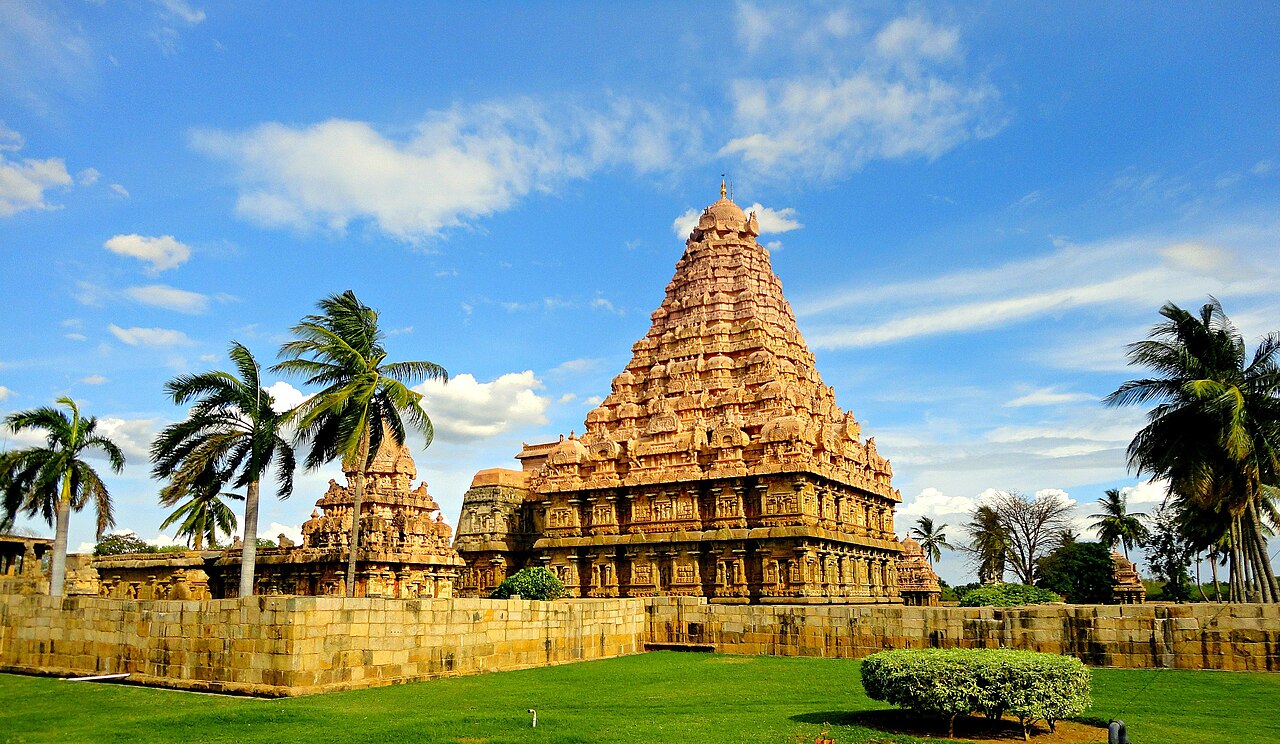
There is a temple in Tamil Nadu that should be more famous than it is. Rising from the flat Cauvery delta with a vimana that soars thirty metres into the sky, the Brihadeesvara at Gangaikonda Cholapuram was built in the early eleventh century by a king who had just returned from leading an army to the banks of the Ganges. Rajendra I — Rajendra the Great, Gangaikonda, the one who brought the Ganga — built his new capital and its centrepiece temple not merely as acts of devotion but as declarations of supremacy. The water of the sacred river, carried south in golden vessels by vanquished kings, was poured into a great tank beside the temple. The meaning was unambiguous: the south had reached the north, and the north had acknowledged it.
That moment of triumphant choreography was the culmination of something that had been building for centuries — a pattern of contest and counter-contest between the great powers of peninsular India that reshaped kingdoms, redirected trade, and produced, almost as a byproduct of its violence, some of the most magnificent art and architecture the subcontinent has ever seen. To understand Rajendra and his temple, you must understand the long rivalry between the Pallavas of Kanchipuram and the Chalukyas of Badami, and then the even longer, fiercer contest between the Cholas and the Western Chalukyas of Kalyani. These were not separate stories. They were chapters of the same book, and the book was written in stone as much as in blood.
Part One: The Pallava-Chalukya Wars
The World of the Sixth Century
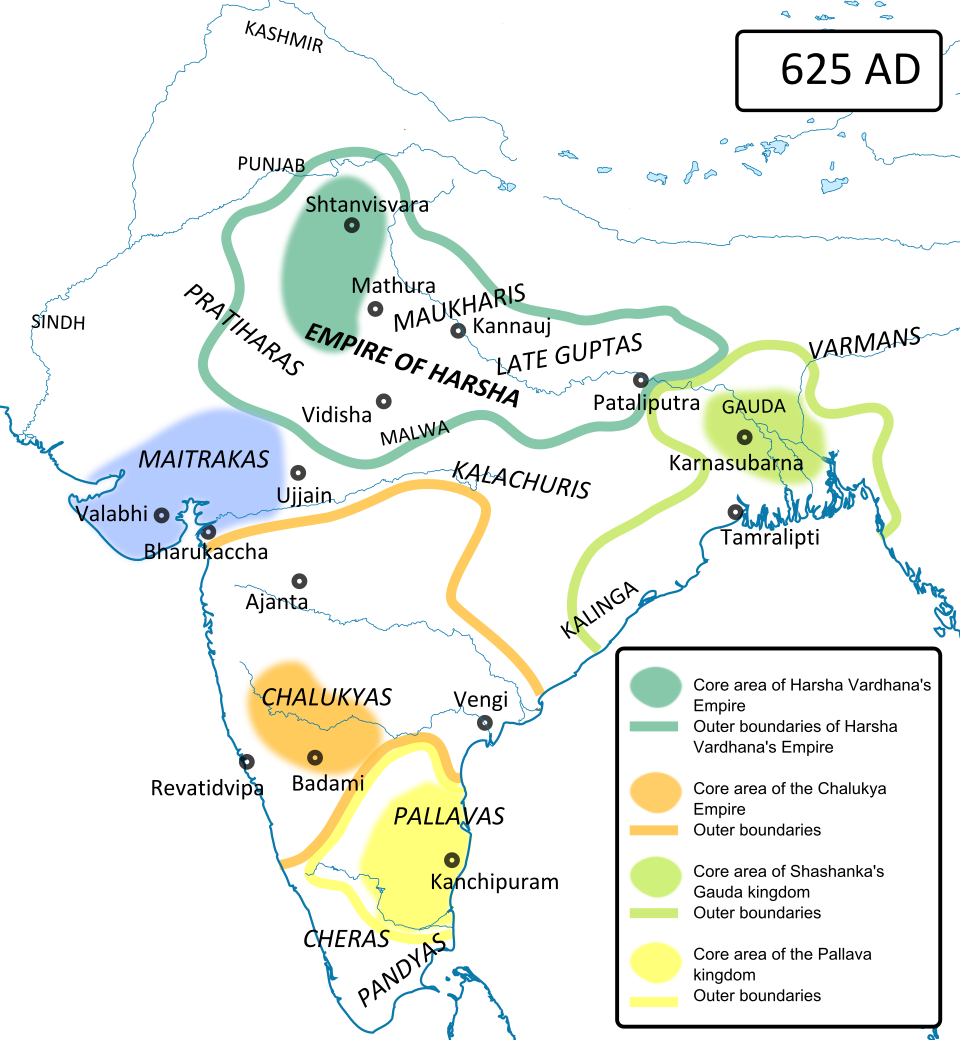
By the early sixth century, the political geography of peninsular India had crystallised around two emerging powers separated by the natural boundary of the Tungabhadra and Krishna rivers. To the north of this line, in the rocky plateau country of what is now northern Karnataka, the Chalukyas of Badami were building a kingdom from a base at Vatapi — the modern Badami. To the south, in the Tamil country and the southeastern coast, the Pallavas of Kanchipuram had established themselves as the dominant power, their capital at Kanchi the foremost city of the Tamil world and one of the great centres of Sanskrit learning in the subcontinent.
These two powers were not natural enemies in any simple sense. They shared cultural frameworks — both patronised Sanskrit alongside regional languages, both built in the Brahmanical temple tradition, both claimed descent from legendary lineages designed to confer cosmic legitimacy. What made them rivals was geography and appetite. The fertile country of the Vengi region on the eastern coast — roughly modern Andhra Pradesh — lay between them, prosperous and strategically positioned to project power either northward or southward. Control of Vengi meant control of the eastern seaboard’s trade and the revenue it generated. It was worth fighting for, repeatedly and at great cost.
Pulakesi II and the Limits of Pallava Power
The conflict entered its first great crisis during the reign of Pulakesi II, who ruled the Chalukya kingdom from approximately 610 to 642 CE and stands as one of the most formidable figures of early medieval India. Pulakesi was, above everything else, an expansionist. He consolidated Chalukya power in the Deccan, checked the southward advance of Harsha of Kanauj in the north, received the embassy of the Sasanian emperor Khosrow II, and turned the full weight of Chalukya military ambition against the Pallavas.
The Pallava king he faced was Mahendravarman I — a remarkable figure in his own right, a playwright, musician, and poet whose conversion from Jainism to Shaivism shaped the religious culture of the Tamil country for generations. But Mahendravarman was not a military match for Pulakesi. The Chalukya advance pushed deep into Pallava territory, and though Mahendravarman managed to contain the invasion and prevent the fall of Kanchipuram itself, the humiliation was real and the territorial losses were significant. Pulakesi celebrated his victories with inscriptions that described the Pallava king fleeing before him.
History’s verdicts are rarely delivered on the battlefield. Pulakesi had humiliated Mahendravarman. His own end would come at the hands of Mahendravarman’s son — and it would come with a completeness that reversed every one of his gains.
That son was Narasimhavarman I, who would go by the epithet Mamalla — the great wrestler — and who would prove to be one of the most consequential military commanders of his age. Narasimhavarman did not merely seek to recover Pallava losses. He sought total reversal. His army marched north not once but twice, and in the campaign of approximately 642 CE it accomplished something unprecedented: it sacked Vatapi itself, the Chalukya heartland, killing Pulakesi II in the process. Narasimhavarman took the title Vatapikonda — he who took Vatapi — and the poet Dandin celebrated the victory in verses that would echo through Tamil literary history. A king who had seemed to threaten the very survival of the Pallava state had been destroyed in his own capital, and the Pallava general Paranjoti brought back the image of the Chalukya god Ganesha as a trophy to Kanchipuram.
The Long Oscillation
What followed the fall of Vatapi was not, however, Pallava supremacy. It was something more instructive: a century and a half of oscillating advantage in which neither power could deliver the knockout blow that would end the contest permanently. The Chalukyas recovered, rebuilt, and struck back. The Pallavas regrouped, innovated, and responded. The Vengi region changed hands. Armies marched north and south along routes that became so familiar they were almost ritualised. Each major engagement produced its own inscriptions, its own epithets, its own literary celebrations — and then the pendulum swung again.
Vikramaditya I recovered Badami and reimposed Chalukya control over much of the Deccan in the years following his father Pulakesi II’s death. Vikramaditya II went further: he invaded the Tamil country and occupied Kanchipuram not once but twice, in feats of arms that demonstrated the continuing capacity of Chalukya power to project itself deep into Pallava territory. Crucially, however, Vikramaditya II did not sack the city. Contemporary records suggest that he left Kanchi’s temples and monuments untouched, a restraint remarkable for the period, and commissioned his own monument at Pattadakal — the magnificent Virupaksha temple — as a commemoration of his victory over the Pallavas. He had proven his dominance without destroying what he had conquered, a calculation that speaks to the complex relationship these rival courts had with each other’s culture and prestige.
The Pallava response came under Nandivarman II and, most significantly, under the naval and diplomatic manoeuvres of the later Pallava kings. The Pallavas had understood early that the sea was as important as the land. Their port at Mamallapuram — named for Narasimhavarman Mamalla — was the gateway to Southeast Asian trade, and Pallava cultural influence had travelled those sea routes to Cambodia, Java, and Champa in ways that no Chalukya cavalry could follow. This maritime dimension of Pallava power was not incidental to the dynasty’s survival; it was central to it. The wealth and prestige that flowed from overseas connections allowed the Pallavas to sustain their resistance through reverses that might have finished a purely land-based power.
What the Rivalry Built
It is one of the enduring ironies of the Pallava-Chalukya wars that the contest which consumed so much blood and treasure simultaneously produced two of the richest artistic traditions in Indian history. The Pallavas at Kanchipuram and Mamallapuram developed the Dravidian temple style in forms of extraordinary refinement — the rock-cut rathas of Mamallapuram, carved in the seventh century, represent experiments in architectural form that would not reach their full flowering for another four hundred years. The Shore Temple at Mamallapuram, standing where the land meets the sea, was among the first structural stone temples built in South India. The Kailasanatha temple at Kanchipuram, built by Rajasimha in the early eighth century, established the canonical vocabulary of the Tamil temple — the gateway tower, the colonnaded hall, the sanctum enclosed in its own narrative world of sculpted figures.
The Chalukyas at Badami and Aihole and Pattadakal were doing something parallel and in dialogue with it. The cave temples at Badami, cut from sandstone cliffs in the late sixth and early seventh centuries, demonstrate a synthesis of northern and southern architectural ideas that is entirely their own. The Durga temple at Aihole is one of the earliest attempts to solve the problem of the curved northern shikhara in stone. And Pattadakal — designated a UNESCO World Heritage Site and deserving of far greater attention than it receives — contains temples in both the northern Nagara and southern Dravida styles, built side by side as if the Chalukya kings were conducting a deliberate aesthetic experiment, drawing on everything the peninsula had to offer and forging from it something new.
The Pallava-Chalukya wars did not interrupt the creation of art. They generated it. Each dynasty built more magnificently as the contest intensified, as if magnificence itself were a weapon and beauty a form of territorial claim.
The wars eventually ended not through decisive military victory but through dynastic collapse. The Rashtrakultas overthrew the Chalukyas of Badami in 753 CE, and the Pallavas were gradually absorbed by the rising power of the Cholas through the ninth and tenth centuries. But the civilisational legacy of their two-hundred-year contest outlasted both dynasties by a millennium. Every subsequent temple tradition in South India — Chola, Vijayanagara, Nayak — built on foundations that the Pallavas and Chalukyas had laid in stone during their wars.
Part Two: The Chola-Chalukya Wars
The New Contestants
By the middle of the tenth century, the political map of peninsular India had been redrawn. The Pallavas were gone, absorbed into the expanding Chola state that had made Thanjavur its capital and the Cauvery delta the heartland of a new imperial project. The Chalukyas of Badami had been gone for two centuries, replaced first by the Rashtrakutas and then, in 973 CE, by a Chalukya revival — the Western Chalukyas of Kalyani, who reclaimed the old name and the old ambitions and established their capital at Kalyani in modern Karnataka. Between these two resurgent powers lay the same contested geography that had defined the earlier rivalry: the Deccan plateau, the Vengi region on the eastern coast, and the invisible line between the Tamil south and the Kannada-speaking north that no dynasty seemed able to hold permanently.
The Chola empire that the Western Chalukyas confronted was something qualitatively different from the Pallava state. Under Rajaraja I, who came to power in 985 CE, and his son Rajendra I, the Cholas had built an imperial structure of remarkable sophistication: a professional army, a powerful navy, an administrative system capable of extracting and deploying the surplus of the Cauvery delta across continental distances. Rajaraja had subjugated the Pandyas, incorporated Sri Lanka into the Chola domain, and conducted naval campaigns in the Maldives. He had built the great Brihadeesvara temple at Thanjavur — the Rajarajesvaram — as a statement of imperial theology, its vimana rising sixty-six metres to become the tallest structure in the subcontinent. His son Rajendra would take everything his father had built and extend it further than any Tamil king before or since.
Rajaraja and the Opening Moves
The Chola-Chalukya conflict under Rajaraja I was a contest fought primarily for the control of Vengi, that perennially contested coastal region whose Eastern Chalukya rulers had become entangled through marriage with the Chola royal family. When the Western Chalukyas of Kalyani attempted to bring Vengi under their suzerainty, they were directly challenging Chola interests in the region. Rajaraja responded by sending armies into the Deccan that engaged the Chalukya forces in a series of campaigns that established Chola dominance over much of the eastern seaboard and demonstrated that the Tamil south now possessed the military capacity to project power northward on terms no predecessor had achieved.
The campaigns of Rajaraja I were notable for their strategic coherence. Rather than conducting raids, the Chola king was establishing facts on the ground — installing client rulers, extracting tribute, building administrative relationships that would persist beyond the army’s withdrawal. This was imperial statecraft, not mere warfare, and it distinguished the Chola approach to the Deccan from the oscillating raid-and-recover pattern that had characterised the Pallava-Chalukya conflict. Rajaraja was not trying to humiliate his enemies. He was trying to build a system in which Chola supremacy was structural rather than episodic.
Rajendra I: The Empire at Its Zenith
If Rajaraja built the system, Rajendra I tested it to its absolute limits — and found that the limits were further than anyone had imagined. Ascending the throne in 1014 CE after a decade of joint rule with his father, Rajendra presided over what was arguably the most ambitious programme of military expansion in medieval Indian history. The campaigns he conducted, and the order in which he conducted them, reveal a strategic mind of the first order.
Against the Western Chalukyas, Rajendra pursued his father’s policy with renewed intensity. The Chalukya king Jayasimha II was a formidable opponent who had restored much of his dynasty’s power after the setbacks of Rajaraja’s reign. The wars between them were fought across the Deccan plateau in a series of engagements that went back and forth without either side achieving the decisive advantage that would end the conflict. Chola inscriptions from this period record victories in language of extravagant celebration. Chalukya records describe the same events from the opposite perspective. The truth, as so often in medieval Indian history, lies in the pattern rather than any single engagement: neither the Cholas nor the Western Chalukyas could destroy each other, but the Cholas consistently demonstrated a capacity to penetrate Chalukya territory that their rivals could not reciprocate in kind.
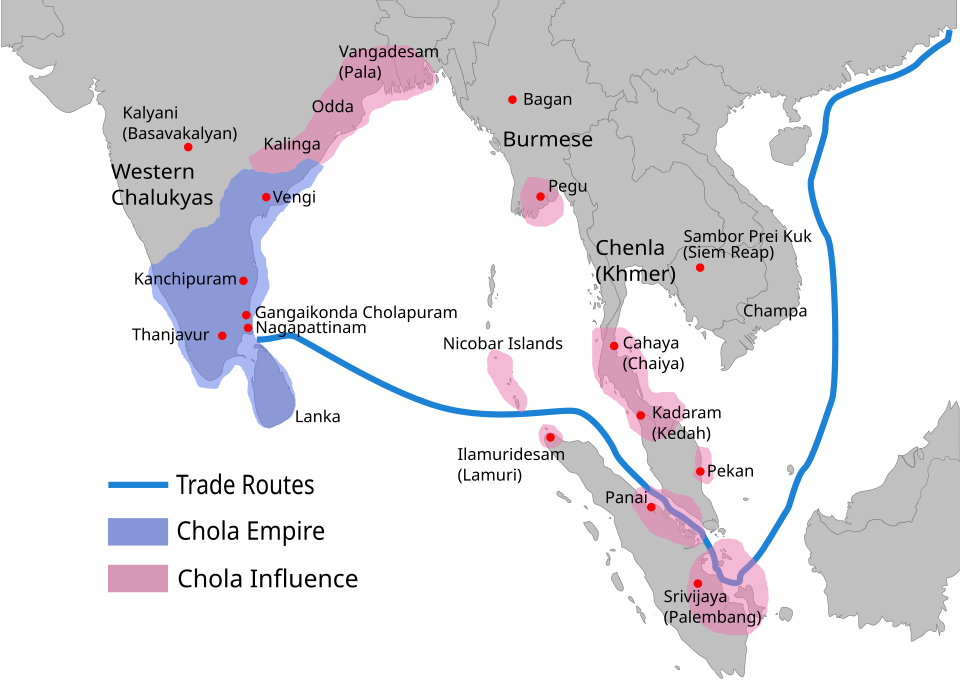
Rajendra understood that the north could not be permanently held from the south. What it could be was permanently reminded of southern power. His campaigns were as much performances of supremacy as they were military operations — each one designed to be witnessed, recorded, and remembered.
The northern campaign of approximately 1022–1023 CE was the most spectacular of these performances. Rajendra sent his armies on a march that took them through the Deccan, across the Godavari and Krishna rivers, through Odisha, and ultimately to the banks of the Ganga itself. The campaign was not designed to hold this territory — the logistical realities of the era made permanent occupation of the Gangetic plain from a Tamil base impossible. Its purpose was symbolic and political: to demonstrate that the Chola state could reach places no South Indian power had reached before, and to extract from the rulers encountered along the way the submission that converted military superiority into acknowledged prestige. The golden vessels of Ganga water brought back to Gangaikonda Cholapuram were the distillation of that ambition into a single, indelible image.
Equally extraordinary, though less celebrated in popular memory, were Rajendra’s naval campaigns in Southeast Asia. The expedition of 1025 CE against the Srivijaya empire — the maritime power that controlled the Strait of Malacca and dominated the trade routes between India and China — was the most ambitious naval operation in South Asian history up to that point. Chola fleets struck at Srivijayan ports from Sumatra to the Malay Peninsula, not to establish permanent colonies but to break Srivijaya’s stranglehold on Indian Ocean trade and open the sea lanes for Tamil merchants. That a king conducting major continental campaigns in northern India was simultaneously directing naval expeditions across the Bay of Bengal speaks to the extraordinary administrative and military capacity of the Chola state at its peak.
The Long War After Rajendra
The conflict between the Cholas and the Western Chalukyas did not end with Rajendra. It continued, in various forms and with varying intensity, through the reigns of Rajendra’s successors and the successors of their Chalukya adversaries. Kulottunga I, who came to the throne in 1070 CE, was himself of mixed Chola-Eastern Chalukya lineage, a dynastic fusion that spoke to the complicated political relationships the long rivalry had generated. The wars continued to be fought along the familiar axes — Vengi, the Tungabhadra corridor, the Deccan plateau — with neither side achieving the permanent domination that would have rendered further conflict unnecessary.
What eventually ended the Chola-Chalukya rivalry was not military decision but political transformation. The Western Chalukyas disintegrated in the twelfth century, replaced by successor powers including the Hoysalas of Dvarasamudra and the Kalachuris. The Chola state, for its part, entered a gradual decline after the mid-twelfth century, its administrative coherence fraying under the pressures of succession disputes and the rising power of the Pandyas to the south. By the time both dynasties had effectively dissolved, the political world of the peninsula looked entirely different from the one in which their rivalry had begun. But the contest between them had, over two centuries of sustained conflict, produced consequences that outlasted both.
What the Rivalries Made
It is tempting, surveying six centuries of warfare between these dynasties, to conclude that the most important thing the rivalries produced was exhaustion. The Pallavas and the first Chalukyas wore each other down until both were displaced by new powers. The Cholas and the Western Chalukyas fought to a kind of strategic stalemate that neither could resolve. And yet this reading, while not wrong, misses what is most significant about these contests.
The Pallava-Chalukya and Chola-Chalukya rivalries were engines of civilisational production on a scale that few conflicts in world history can match. The competition for prestige that ran alongside the competition for territory drove both sets of dynasties to invest in art, architecture, literature, and religious patronage at levels that transformed the cultural landscape of South Asia permanently. The Pallavas did not build the Shore Temple and the Kailasanatha at Kanchipuram despite being at war with the Chalukyas. They built them partly because of it. The Western Chalukyas did not commission the sculptural programme at Pattadakal despite having just fought the Cholas. They commissioned it partly in response to the cultural prestige of the Chola court.
The Brihadeesvara at Thanjavur and its twin at Gangaikonda Cholapuram are the supreme expressions of this dynamic. Rajaraja built the first to announce the arrival of an imperial state. Rajendra built the second to record the furthest reach of that state’s ambition. Both temples are military monuments as much as religious ones — their proportions, their inscriptions, their iconographic programmes all speak a language of power. And yet they are also, indisputably, among the most beautiful things human beings have ever constructed. That beauty was not incidental to their political purpose. It was the political purpose.
There is also a broader civilisational legacy to consider. The long rivalry between these dynasties created sustained conditions for the exchange of ideas across the Deccan’s cultural boundary. Architects, scholars, poets, and religious teachers moved between the courts of enemies as readily as they moved between allied kingdoms. The Dravidian temple style that the Pallavas pioneered was studied and adapted by the Chalukyas. The Nagara forms of the north found their way, modified and reinterpreted, into the Chalukya experiments at Aihole and Pattadakal. The Chola administrative system owed debts to predecessors and rivals whose influence could not be fully disentangled from the legacy of war.
Stand at Gangaikonda Cholapuram today — in the flat, quiet Tamil countryside, with the great vimana rising above the coconut palms — and what you are seeing is not merely a temple. You are seeing the endpoint of a six-hundred-year argument about who the Indian peninsula belonged to, conducted in stone and bronze and blood across an area larger than Western Europe. The argument, in one sense, was never resolved: no dynasty achieved the permanent supremacy it sought, and the political world these kings fought over was eventually replaced by something none of them could have imagined. But in another sense, the argument produced its own answer. The civilisation that emerged from the contest — its temples, its literature, its administrative traditions, its artistic vocabulary — was the inheritance of everyone who came after. Not the victory of one dynasty over another, but the creation of something that belonged to all of them, and that belongs, still, to us.
