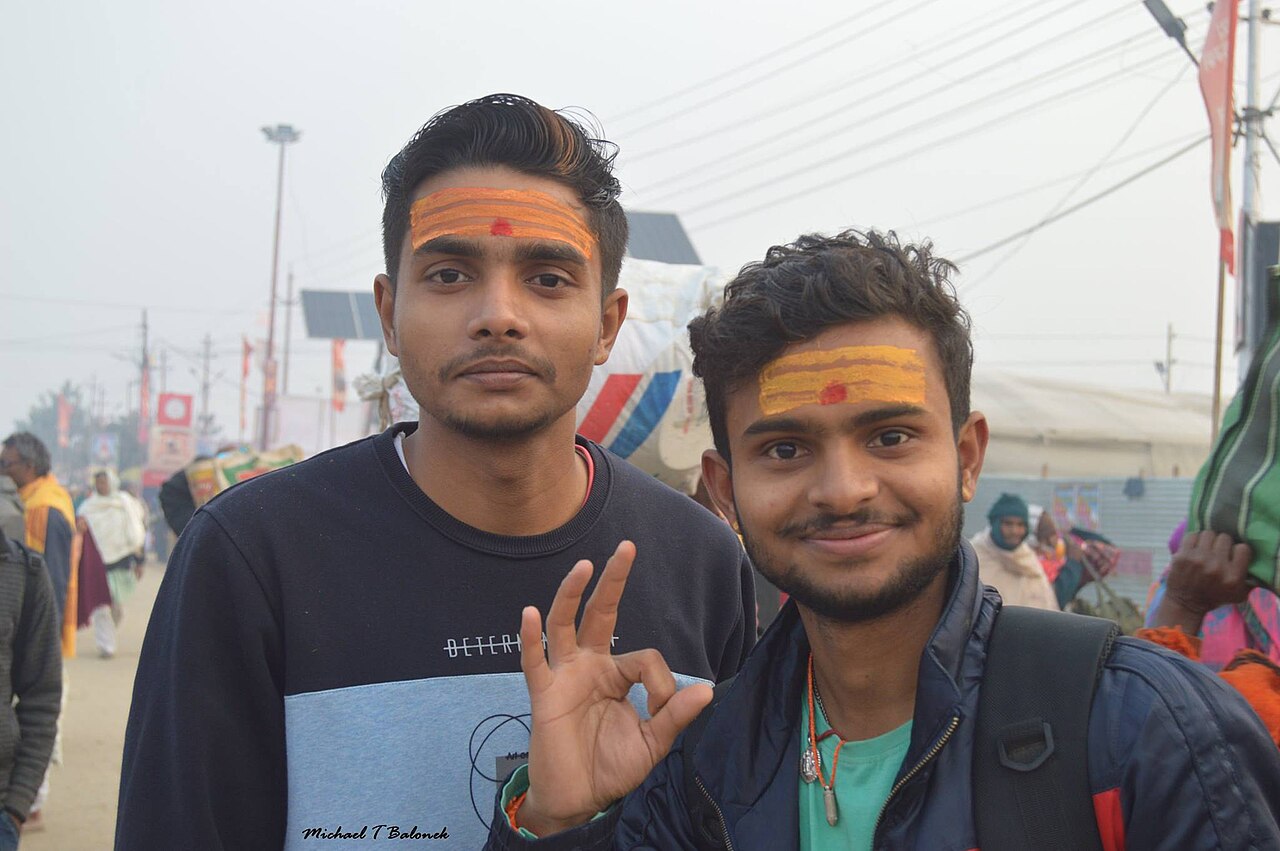
You have a tattoo on your forearm. A sleeve, maybe — intricate, expensive, chosen with care, worn with pride. You show it without hesitation. At work, at the gym, at dinner. It is a statement. It is you. Nobody told you to be self-conscious about it and you wouldn't listen if they did.
But the vibhuti on your forehead after your morning sandhyavandhanam — that you wiped off before leaving the house. Not because you forgot. Because you didn't want the looks. Because you didn't want to explain. Because somewhere in the back of your mind, without anyone having to say it explicitly, you absorbed the message that the tattoo is individual expression and the vibhuti is a cultural embarrassment.
This essay is addressed to you. And it has one central argument to make.
The vibhuti is older, deeper, more hard-won, and more genuinely defiant than any tattoo that has ever been applied to any skin anywhere in the world. And the ancestors who kept it — who wore their tilaks and their naamams and their bindis through invasion and colonialism and the long campaign of modernist contempt — were not old-fashioned. They were, by any serious definition of the word, rebels.
What Cool Actually Is
Let us think for a moment about what we mean when we call something cool. At its core, coolness is a form of defiance. The tattoo is cool because it says: I don't care what the conservative mainstream thinks of my body. The purple hair is cool because it says: I refuse to look like everyone else. The eyebrow ring is cool because it performs a deliberate departure from the expected — a small, visible assertion of individual identity against the pressure to conform.
Every one of these markers of contemporary cool is, at bottom, an act of non-conformity. A refusal to be invisible. A declaration that I will be seen on my own terms.
Now tell me — what is the tilak?
The tilak is a mark placed on the forehead in the name of a specific deity, in the context of a specific philosophical tradition, connecting the wearer to a lineage of practice that runs back thousands of years. It is, by definition, non-conformist in any context where the dominant culture is not Hindu. It marks you as someone who has a living relationship with something ancient and specific — not a vague spiritual inclination but a named tradition, a named deity, a named community. It says: I am this. Not that. This.
In a cultural environment that consistently pressures Hindus to become invisible — to assimilate, to secularise, to keep the gods indoors and the marks off the face — wearing the tilak is an act of defiance of exactly the same order as the tattoo or the purple hair. It is more defiant, in fact, because it carries more history, has cost more, and refuses a pressure that goes back not a few decades but several centuries.
What It Cost to Keep the Mark
Here is what the young Hindu who wipes his vibhuti off before leaving the house may not fully know. The mark he is wiping off was kept by his ancestors under conditions that make social awkwardness look like nothing at all.
When the armies of Mahmud of Ghazni swept through the temples of northwestern India in the eleventh century — when Somnath was destroyed, its priests killed, its sacred image desecrated — the Hindus who survived did not stop wearing their marks. They buried their deities. They hid their texts. They continued their worship in private, in houses, in the forests, in whatever space remained. The tilak did not disappear. The bindi did not disappear. The naamam did not disappear. They were worn in the full knowledge that visibility could mean violence.
Under the Delhi Sultanate and the Mughal Empire, the practical exercise of the dhimmi framework — the subordination of non-Muslim populations — created sustained social and economic pressure on Hindu practice. Jizya was levied. Temple construction was restricted. In the most aggressive periods, conversion was incentivised through a combination of privilege for those who crossed and disadvantage for those who did not. And yet the marks persisted. The puja continued. The festivals were celebrated — sometimes openly, sometimes quietly, but they were celebrated. The thread of continuous practice was never fully cut, despite sustained effort to cut it.
"The bindi on your grandmother's forehead is not a fashion choice she made in a comfortable cultural environment. It is the end point of a chain of transmission that passed through centuries of active effort to break it."
The bindi on your grandmother's forehead is not a fashion choice she made in a comfortable cultural environment. It is the end point of a chain of transmission that passed through centuries of active effort to break it. Every woman in that chain who kept her bindi was making a choice — sometimes a costly one — to remain visible as what she was. To refuse the erasure that was being offered to her.
The Finesse Method — Colonial Shame
The Islamic invasions used force. The European colonial project used something more insidious: shame.
The British colonial enterprise, and the missionary tradition that accompanied it, did not primarily seek to convert Hindus by violence — though that happened too, in various forms. What it primarily did was construct a discourse in which Hindu practice was primitive, superstitious, irrational, and unworthy of a civilised person. The tilak became an idol-worshipper's mark. The bindi became a pagan superstition. The puja became a primitive ritual performed by people who had not yet been elevated by the benefits of Western education and Christian civilisation.
This was not a peripheral aspect of colonialism. It was central to its project. The goal was not merely political control but the production of what Macaulay famously described — a class of persons Indian in blood and colour but English in tastes, in opinions, in morals, and in intellect. A Hindu who was ashamed of his Hinduism was a more cooperative subject than one who was not. The shame was a governance tool.
And it worked — partially, and in ways that persist. The educated Hindu elite that colonialism produced often internalised the colonial judgment of their own tradition. They kept the festivals but apologised for the superstition. They maintained the family puja but explained to English acquaintances that it was really just cultural tradition, not literal belief. They wore Western clothes and put the traditional marks away for domestic use. They became the deracinated Hindu that the colonial project wanted to produce — connected enough to the tradition to be counted Hindu, ashamed enough of it to not challenge the colonial hierarchy of the civilised and the primitive.
The young Hindu who wipes his vibhuti off before leaving the house in 2026 is performing, without knowing it, an act that the British colonial project spent two centuries trying to produce. He has absorbed the shame without knowing where it came from or what purpose it originally served.
The Modernist Contempt
After colonialism came a third wave of pressure — less violent than the medieval invasions, less systematic than the colonial project, but in some ways more pervasive because it comes not from outside the Hindu community but from within it.
The post-independence Indian secular modernist project — shaped significantly by the Nehruvian vision of a scientific, rational, forward-looking India — had limited patience for the visible markers of Hindu religious identity. Not because it was anti-Hindu in the straightforward sense, but because it had absorbed the colonial framework's hierarchy of the rational and the superstitious, and applied that hierarchy to its own tradition. The tilak was not colonialism's mark of the primitive — it was modernity's mark of the backward. The person who wore one to the office was not sophisticated. The bindi was not a mark of oppression — it was a mark of the village, of the uneducated, of the woman who had not yet entered the modern world.
This contempt was never stated as policy. It was communicated through a thousand smaller signals — through what the educated urban class wore and did not wear, through what Bollywood celebrated and ignored, through the steady cultural message that the sophisticated Indian was the secular Indian, and the secular Indian was the one who kept the gods at home and left the marks off the face in professional contexts.
The result, across two or three generations, was a generation of young Hindus for whom the bindi is something their grandmother wears — associated with the village, with the uneducated, with the past — and the tattoo is something they wear, associated with cosmopolitan sophistication, individual expression, and cool. The hierarchy has been completely reversed from what it should be. The mark with thirty centuries of history behind it is embarrassing. The mark with thirty years of history behind it is cool.
Hinduism Is Rebellion
There is something deeper here that the young Hindu deserves to understand about his own tradition — something that the shame campaign, in all its forms, has been specifically designed to obscure.
Hinduism is, at its philosophical core, the most radically pluralist religious tradition in human history. It is the tradition that said, before anyone else said it with equivalent philosophical rigour, that truth is one though the wise call it by many names — and then built an entire civilisation on that insight, generating hundreds of distinct philosophical schools, devotional traditions, deity cults, and ways of being in the world, all coexisting without requiring any of the others to disappear.
This is not a tradition of standardisation. It is a tradition of irreducible individual and community-specific expression. The Shaiva who wears the vibhuti, the Vaishnava who wears the naamam, the Shakta who wears the red bindi, the Smarta who maintains the panchayatana puja — each is expressing something specific, rooted, and non-interchangeable. Each mark carries a specific theology, a specific devotional relationship, a specific philosophical lineage. None is a generic spiritual accessory. Each is a declaration of particularity in the face of every pressure toward homogenisation.
The forces that have attacked Hindu civilisation — the medieval iconoclasts, the colonial missionaries, the modernist secularists, and now the evangelical demonisers of Frisco, Texas — share one thing. They are all, in different ways, standardisers. They all require that the plurality be reduced to the singular. That the many gods give way to the one God. That the specific, rooted, community-specific marks of Hindu identity give way to the universal, the generic, the unmarked.
Hindu practice, in its insistence on specific deities, specific marks, specific traditions that resist absorption into a universal generic spirituality, is structurally resistant to this standardisation. It is, in the most precise sense, a rebellion against the erasure of individual and community expression. And the young Hindu who wears his vibhuti to work, who keeps her bindi at the office, who wears his naamam on the street — is participating in that rebellion whether he knows it or not.
To the Young Hindu Directly
Let me speak without the apparatus of historical argument for a moment.
You are living in a cultural moment that celebrates visible self-expression as a fundamental human right. That celebrates the tattoo, the piercing, the dyed hair, the deliberate departure from the mainstream as markers of authentic individual identity. That has entire industries dedicated to helping people look different, feel different, be seen as distinct rather than generic.
Your tradition has been doing this for three thousand years. Not with needles and ink but with ash and kumkum and sandalwood paste. Not as aesthetic choice but as theological statement. Not as fashion but as relationship — a relationship with a specific deity, a specific philosophical tradition, a specific community of practice that connects you to every ancestor who kept the same mark under conditions you will hopefully never face.
The vibhuti on your forehead is not your grandfather's embarrassment. It is your inheritance — one that was kept for you through Islamic invasions that destroyed thousands of temples, through colonial shame campaigns that lasted two centuries, through the modernist contempt that tried to make your tradition into something to be kept private and apologised for in public. The people who kept it for you were not unsophisticated. They were not unaware of the pressure to remove it. They kept it anyway. For reasons that mattered to them and that should matter to you.
"The bindi is not old-fashioned. It is the most defiant thing a woman can put on her face in a world that has spent centuries trying to get her to remove it."
To the Hindu woman who has stopped wearing her bindi because it draws attention, because it feels old-fashioned, because the office environment makes her feel that it belongs to a world she has left behind — I want to say this directly. The bindi is not old-fashioned. It is the most defiant thing a woman can put on her face in a world that has spent centuries trying to get her to remove it. The British colonial project wanted it gone. The missionary tradition wanted it gone. The modernist secular project wanted it confined to domestic space. And now the evangelical accusers of the American suburb want it classified as devil worship.
Every one of those forces has failed. The bindi is still here. Your grandmother wore it. Your great-grandmother wore it through partition, through poverty, through displacement, through every condition that the twentieth century imposed on the people of this civilisation. It arrived with you, in this country, in this century, as a gift from everyone who refused to remove it when removal was the easier choice.
Wear it. Not because someone told you to. Because you understand what it cost to get it to you. And because the world that wants you to remove it does not deserve the compliance.
The Mark Is the Message
There is a generation of young Hindus coming of age in the diaspora and in India who are simultaneously the most educated, most professionally accomplished, most globally connected generation in the history of their civilisation — and the most uncertain about whether their tradition is something to be proud of or something to be managed.
That uncertainty was manufactured. It did not arise spontaneously. It was produced, over centuries, by a sustained campaign to make Hindu practice feel primitive, superstitious, embarrassing, and incompatible with the sophisticated modern self. And it has been sufficiently successful that a generation of young Hindus has internalised the hierarchy — tattoo cool, tilak not cool — without ever examining where that hierarchy came from or who benefits from it.
The answer to manufactured shame is not an argument. Arguments can be countered. The answer is a mark. Placed on the forehead. Worn without explanation. Carried into every space — the office, the classroom, the street, the social gathering — as simply what you are, without apology and without the performance of embarrassment that the shame campaign requires to sustain itself.
Hinduism survived because ordinary people — not philosophers, not kings, not armed resisters, but ordinary men and women going about their ordinary lives — kept the marks. Kept the puja. Kept the festivals. Kept the thread of specific, rooted, living practice intact through every attempt to cut it. They did not survive by explaining themselves to the people trying to erase them. They survived by refusing to be erased.
That is your inheritance. It is also your instruction.
Wear the mark. It is a war wound. It is a declaration. It is the most defiant thing you own.
